Shortly after Melissa arrived in Maputo in late 1987, she received a call from Marcelina Chissano, wife of Joaquim Chissano, President of Mozambique. “She asked me if I could come immediately to have tea with her and discuss a very urgent issue: about a dozen children had just been captured by Government troops firing weapons against the soldiers and fighting with the rebels. I rushed over right away, and the details were that the children’s ages ranged from about 11-14 and that they were now in prison, held as enemy combatants. More children had been captured and were expected to arrive in Maputo, the capital of Mozambique, shortly. We agreed that these children should not be kept in prison but rehabilitated. I promised to proceed to try and implement such a project,” recalled Melissa.
During this time, Renamo rebel guerrillas would attack remote villages and kill many of the adults, sometimes forcing the boys to commit atrocities and become soldiers. Many of these children fled the villages and became orphans, often having suffered mutilation. Many feared retribution by their neighbors and relatives. Most of them did not know the name of their village, much less its location. They did, however, know the names of some relatives.
She continued: “We in the United States Government are used to emergency programs, where we send food, medical supplies, tents and blankets. But ‘shrinks’ [psychologists]! That was something else. After discussions, the State Department approved a project which set up a hostel for the child soldiers and brought down to Mozambique a well-known child psychologist, Dr. Neil Boothby from Duke University. The idea was to set up a training model to train local people as there was not one trained psychologist in all of Mozambique. The training consisted of sizing up the children, spotting those that might be suffering from post-traumatic stress disorder, how to assess it, how to draw out the child, how to deal with it, often through psychodrama.” As the number of boys increased, the age range expanded to 8-16 years old.
She focused on getting funding from USAID, the US aid agency, for an initiative to reunite these orphans with their families. “She was front and center on this,” recalls Michael Ranneberger, who was the second-in-command at the US Embassy in Maputo.
Neil Boothby was seconded by Duke University to Save The Children (SCF), a non-governmental organization that played a key role in implementing this project. He recalls that “Melissa was able to call upon her personal relationships to make things happen. The first was with Julia Taft, who was the head of the US Office of Foreign Disaster Assistance (OFDA) at the time. A phone discussion resulted in the initial start-up funds ($80,000) for the Lhanguene initiative. It is the first time (and the only time) that OFDA funded a child soldier project.”
In addition, Boothby wrote that “Melissa and her husband knew Alan Parker and his wife who had the Oak Foundation. Alan Parker owned tax-free stores in airports. This was bridge funding, with USAID making substantial contributions thereafter. Senator Patrick Leahy created the Displaced Children and Orphan Funds (DCOF) and the Mozambique child soldier project was its first allocation. She had several discussions with Senator Leahy–and Terry Peal, the senior legislative assistant on the House foreign assistance committee at the time–visited Mozambique as part of this commitment. The visit sealed the ‘deal’ and set the tone for future DCOF allocations.”
The initiative centered around an orphanage in Maputo where these illiterate orphans were brought in the hopes that they could be identified and reunited with their families. At this center, called Lhanguene, the boys were given food, shelter and, when needed, help from a psychologist. To identify them, they were photographed and asked to talk into a cassette tape recorder about what their village was like and who their relatives and friends were. SCF worked in partnership with the Mozambican Department of Social Welfare, of the Ministry of Health. This government agency mobilized the Mozambican Woman’s Association, which existed in almost all villages and district capitals.
“The orphanage and the therapy for the kids were both heartbreaking and encouraging, but it was very tough to watch some of the reenactments of what caused the trauma,” recalls Beto Bedolfe, who was the USAID project officer for this initiative. Their “personal stories of being forced to murder their parents and worse were truly horrifying.”
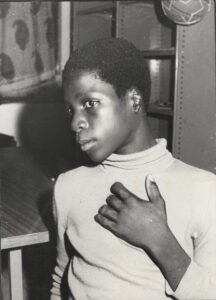
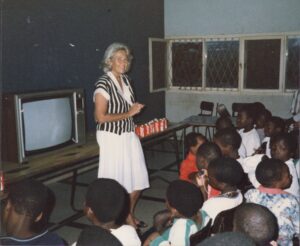
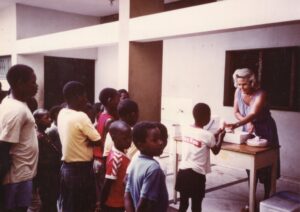
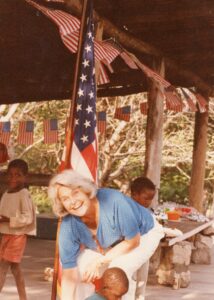
Then teams from SCF, the Mozambican government and the US Embassy would go to villages that government troops had recently recaptured from the rebels.
Carol Smetana, who worked at the US Embassy with Melissa, recalls a visit to a village. “I accompanied Melissa on one trip to film a gathering of dozens of villagers maybe several hours outside Maputo where Renamo had come and gone. We had huge posters with photos of the children that were displayed and passed around, hoping someone would recognize them. Imagine: most of them had never even seen photographs, so they had to process what they were seeing. One elderly woman recognized her grandson, maybe a five-year-old boy, and she came up to the table where Melissa and a couple other team members sat with the cassette tape recorder. They played the message from the grandson. I will never forget the series of expressions that quickly played across her wrinkled, timeworn face. At first shock and incomprehension at the first sounds coming out of that little machine, then realization that she was hearing human voices, followed by tears beginning to roll down her cheeks as she recognized her own grandson speaking.”
Boothby recalls a geopolitical angle of the project. Melissa negotiated a visit by Maureen Reagan, daughter of then President Ronald Reagan. “One of her first stops was the Lhanguene Center–we were literally just getting started. Maureen was ‘wide eyed’ as she listened to the Lhanguene boys talk about their experiences and met with Melissa and me to get a briefing. She returned to DC and met with her father, President Reagan, in the early morning ahead of an 11 AM scheduled meeting with Senator Jesse Helms. Helms wanted the President to support Renamo–Helms claimed it was a Christian entity that opposed communism. President Reagan, after listening to his daughter, told Helms ‘No.’ “
Melissa wrote that “By the time l left Mozambique, we had reunited 2,000 children – 2,000! – in a country at war, where people can’t read, where they have never even seen a photograph of a loved one. To the best of my knowledge, our project in 1988 was the first project in the world dealing with child soldiers, the practice of which today has become a more widespread problem. I am very proud of the work we did, but it was also some of the emotionally most draining work I ever did.”
In 1991, the US Foreign Service Journal carried an article about Melissa and these war orphans.
In 2004, Wray Herbert wrote an article for the Carter Center, founded by former US President Jimmy Carter, based on interviews with several of the boys who had grown up to be men. It may be found here.
For more information about this project, please see the ADST Oral History Website.