Congo, now Democratic Republic of Congo, was called Zaire in 1991 when Melissa was posted to the capital, Kinshasa. With the mutiny of the Zairian Army, which hadn’t been paid, on September 23, 1991, chaos broke out in much of the country. Melissa had to evacuate people who might be killed as soldiers looted stores, homes, churches, hospitals – everywhere. This evacuation was in addition to having to reduce the embassy’s staff, originally at around 300, by 90%. Her husband Alfred was one of the first to go, as she had to set an example. Within a few days, she had coordinated the evacuation of around 3,000 missionaries, businessmen, engineers, teachers, diplomats, their spouses and children – and their pets.
For example, an American doctor who was doing AIDS research in Zaire had to suddenly leave with his family. The Embassy’s computer chief recounted what he saw.
“As far as the US was concerned, haha, it’s not until you have to run an evacuation that you knew that you were responsible for Canadians, Israelis, and all sorts of other people that you never knew you were responsible for,” she revealed in the ADST Oral History website. “Special planes had to come in because the airport in Kinshasa was closed [due to ransacking by soldiers]. It was unusable and we had to get them across the Zaire River to Brazzaville. (…) We sent small planes in to get the people…. Most men, most of them, a whole bunch of them, came in from the interior who were missionaries and many of them didn’t want to leave. We’d send the plane out and they’d say, ‘No, we aren’t going anywhere.’”
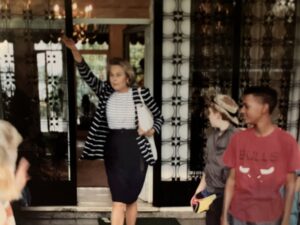
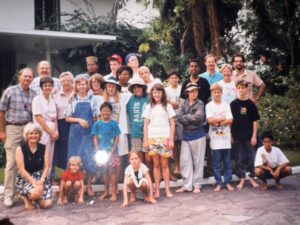
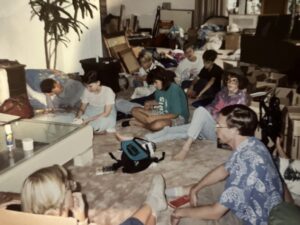
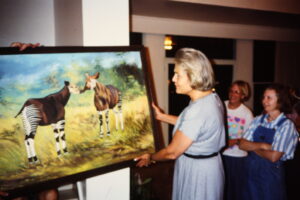
There were many missionaries and their families in Zaire. Melissa sent a truck with armed guards (not soldiers) to the Presbyterian hostel in Kinshasa to pick up those missionaries and their families and take them to the Baptist missionary compound. However, the driver got confused and delivered the Presbyterians, numbering roughly thirty people, to her home, which was the large residence for the US Ambassador near the Congo River. Melissa was surprised but being “extremely gracious and unflappable”, in the words of one of them, took them all into her living room. These families were so grateful that, at the end of their stay, they gave Melissa a painting of an Okapi, which had been at their hostel, with all their signatures on the back. She kept this painting for years on the wall of her home until she died. The painting is now at the home of a reverend in the US.
Several of the people who were evacuated wrote letters thanking Melissa. One of them was Ruth Dumont, who worked at a chimpanzee refuge and was acquainted with Jane Goodall. Here is her letter and obituary.
The State Department gave a $5,000 award to a Zairian employee at the consulate-general in Lubumbashi for his work during the evacuation.
Shortly before she left Kinshasa for her next post, The American School of Kinshasa sent a letter thanking her for the attention she dedicated to the teachers, parents and children.
Read American School of Kinshasa
“The evacuation of the humans was in September 1991,” she added in the ADST Oral History website. “And no sooner had they gotten to Washington, they were sending us messages, ‘Please send me back my cat,’ my dog, my parrot, my whatever.”
“So, the first thing we did, I wasn’t myself involved, but staff collected these animals out of the homes that had been abandoned. Most of the animals were cats and dogs. But we had a good number of parrots, birds, we had a couple of snakes — they were not poisonous. They were constrictor types. Amazing what people will collect! We had one little baby gorilla. But I think he was just on a visit. He wasn’t a permanent pet. We had a home for him right away on the other side of the river — a special place that [famed anthropologist] Jane Goodall kept.” Goodall dined at least once at Melissa’s residence and talked about her work with primates.
An American who worked at the US Embassy in Kinshasa wrote this account of the pet evacuation.
“On September 23, 1991, Kinshasa erupted into riots after a number of soldiers marched on government facilities, demanding higher pay. Within hours Kinshasa was extremely unstable, with widespread looting and over 100 deaths; by the next day Kinshasa was under an “ordered evacuation” status. Dependents (spouses/children of employees), as well as numerous employees deemed “non-essential” left on 25-27 September via ferries from Kinshasa, enroute to Brazzaville, Congo, on the other side of the famed Congo River. Our embassy staff was reduced dramatically at this point, to just 41 personnel, from a previously large number of official personnel. By the weekend, however, things continued to destabilize, and five officers were selected to evacuate to Brazzaville, with hopes that we would be able to return in a reasonable amount of time.
Being among the five officers chosen to go to Brazzaville, we all reported for duty on Monday, 30 September, only to learn that the embassy did not have much for us to do, so we settled in the embassy conference room, and began watching the Clarence Thomas hearings. The next day, again while we were watching the hearings, the Ambassador’s secretary summoned me, saying the Ambassador needed to see me. Being assigned to the political section in Kinshasa, and being a competent French speaker, I was hoping that I was either going back to Kinshasa, or the Ambassador might have some special mission for me. He did indeed have a special mission. The Ambassador said he had just gotten off the phone with Ambassador Melissa Wells, my Ambassador in Kinshasa, and she had an important assignment for me – I was to be the pet evacuation officer. The Ambassador in Brazzaville told me he would put his General Service’s Office (GSO) at my disposition and advised me to get in touch with the pet evacuation coordinator on the Kinshasa side – Dr. Cedric Dumont.
I called Dr. Dumont, who I knew well, and learned that Ambassador Wells was very concerned about reports coming to her that personnel who had been evacuated had left behind a significant number of pets, and the Embassy was having trouble caring for the pets. Furthermore, there were some reports that some families had reportedly killed their pets before their departure, as they feared looters would eat their pets. Ambassador Wells recognized that the State Department could not officially evacuate pets but asked for input about how they could facilitate the movement of pets to the United States. A solution was found – each employee, whether State or another agency – would have to agree to cover the costs of shipping their pet(s), to include the cost of an accompanying officer. In the end, everyone agreed to this, and Ambassador Wells appointed Dr. Dumont for the Kinshasa side and me for the Brazzaville side.
We had some challenges ahead of us. There were 63 dogs and cats to be evacuated, as well as seven chimpanzees from the Kinshasa zoo. I had been with my family several times to the zoo and they previously had about 30 chimps. However, hungry citizens broke into the zoo and began eating all the animals. Only seven chimps remained and Jane Goodall, who was an occasional visitor to Kinshasa, agreed to take the seven to her chimpanzee reserve in the Republic of the Congo. Dr. Dumont worked with GSO on the Kinshasa side to assemble all of the animals, build crates for those who did not have crates, and also to put together shot records and papers, and if there were not any, to come up with suitable substitutes.
On my side the GSO shop from Brazzaville was terrific. I worked with the GSO to book a ferry and three trucks, who would take the animals off to different locations after arriving from Kinshasa. We wanted to take care of all this as soon as possible and if memory serves me correctly, we got the word on Tuesday, and the first animals (the cats) left Brazzaville on Friday, October 4th, followed by the dogs on October 5th. How we got to that point deserves some elaboration.
I first went to the downtown Brazzaville office of UTA, a French airline that has since been taken over by Air France. I explained to the French expat my dilemma – having to send 62 cats and dogs to the U.S., to various locations, and one cat to South Africa. His first reaction was raucous laughter. After I managed to convince him that I was serious, he gathered himself and said that we would have to put the cats and dogs on separate flights, and each flight would have to have an accompanying officer. He said that he did not want the cats and dogs fighting, since they were well known for such activity. I looked at him and said, “You are looking at the only potentially accompanying officer.” He relented and said the cats could go alone, but I must go with the dogs.
Dr. Dumont quickly sent all of the paperwork for the animals over before “d-day,” and then, with the paperwork in hand, went over the next day to the airport and diligently filled out all paperwork for the cats. There were 30 cats going to the US, so this took a lot of time. They were going to Paris, then to Dulles, and then some going to further locations. I fortunately had a GSO Foreign Service National (FSN – acronym for locally employed staff at the time) with me, and he helped with translation, since my Congolese counterparts often preferred the local language to French. I announced to the UTA shipping office that I was then taking off for Kinshasa to go get the cats and dogs and would be back in a couple of hours with the cats, who were leaving that night.
I headed to the port and got on my ferry, which was captained by a Congolese woman, which was a rarity then, as it is now. The current slowed us down and the voyage took longer than expected. When I got to the other side, I could see all of the animals stacked up in their crates, with Embassy staff all around, but behind a locked gate. Not good. I managed to get inside the locked gate, and encountered a still chaotic refugee scene, with people trying to flee Kinshasa and Zairian troops and policemen swinging rubber hoses and truncheons, while well-coiffed French and Belgian paratroopers eyed the scene carefully. I asked the head GSO representative what the problem was, and he said he didn’t know, so I grabbed him and headed to the headquarters building of the port. Having already served for a time in Kinshasa, I was wise to the rampant corruption and schemes and expected we had a hold-up due to an effort along those lines. We were directed to the Commandant’s office and I asked, in French, what the hold-up was, and he said we “had not paid the special pet export tax.” I of course knew that this was a blatant attempt to shake us down and I explained this to my GSO colleague, who was not a French speaker. When he heard this, he replied (in a barely contained rage), “you tell him that if he does not open the gate immediately, we will have one of the French paratroopers shoot off the lock.” The commandant replied immediately, “ca va” (okay), indicating that he knew some English and we were in no mood for his shenanigans. This was none too soon, as it was hot on the dock and we were worried about the animals.
The “portering” of animals began in earnest. My ferry was actually tied up next to a ferry already on the dock, so the myriad Zairian porters carried animals, big and small, across one ferry to another. It was quite a spectacle, especially with chimps reaching out and trying to grab people and their hats in some cases, as they were carried onto the ferry. As I was watching this, a Zairian guy came up to me and said he had just learned that my ferry was broken down, but he could offer me a special price. Again, being wise to the ways of the infamous Zairian kleptocratic methods, I asked him to wait for me, and I went aboard my ferry, only to find my ferry captain in the middle of a black-market transaction. Fortunately, it was only for soap and when I asked her if her vessel was fine, she said of course it was. The “ark” was now full and we set sail for Brazzaville – well within sight – but it still had me reflecting on the fact that we were ferrying unusual cargo across the dark and mysterious Congo river.
We got the other side, but we were well behind schedule. GSO was well organized, as the three trucks were there; one took the dogs to the GSO compound, another took the chimps to Jane Goodall’s reserve, and I got into the truck with the cats and we headed to the airport. When we got there, I apologized for being late, and said the cats were ready to go. The UTA clerk tapped his watch, and said it was too late, and anyway, they had already gotten rid of all of the paperwork that I had so painstakingly filled out. It was my turn to speak English and demonstrate some ire, and turning to my Congolese FSN, I asked him to convince the UTA employee that he better change his mind right away. He did, but I had to fill out all of the paperwork again. Fortunately, I had copies of all of the documents with me. I finished up, and I stood by while the UTA warehousemen put all of the cats onto a pallet and secured them with bungee cords. I verified they had the requisite paperwork and then took off, saying I would see them the next day with the dogs.
I got back to the warehouse and found 32 dogs sitting there in their crates, waiting for me. Unfortunately there was no one else to help me, but I knew that dogs were much more needy than cats, so this involved walking, feeding and watering all of the dogs – all except the mean one who would not come out of his cage and always snapped at me – he got the food and water hurriedly pushed in but no walking. This whole process took about two hours. I made it back to my hotel, weary, but excited to be going the next day, as I would be going back on the flight and I would thus being seeing my wife and two young children (4 and 2), who had just been evacuated to the DC area.
I went to the GSO compound early the next day and a teenaged boy (son of an Embassy staffer) was there to help me with the walking, watering and feeding of the dogs. I then headed to the airport and filled out all of the paperwork. After that was completed, we went back to get the dogs. At the airport I decided that they should be walked, watered and fed again (except again for the mean one), before being palleted. I handled this myself, and it again took two hours. They were palleted under my supervision, and I again verified that they had all of the paperwork. I headed back to my hotel and showered and packed, and hustled back to the airport. I checked in with UTA, and given that this was 1991, there was a lot more flexibility about security, so they let me exit the terminal so I could just check on the dogs one more time. I remember there was a pleasant, light rain falling. When I got to the dogs, I saw two people climbing up on the stacked crates of dogs, and it turned out to be the Ambassador’s wife and none other than Jane Goodall herself. The Ambassador’s wife asked me, “Steve, could you help us get these dogs out, since they need to be walked before the leave?” Although the notion of walking dogs in the rain and having all of that dog hair on me for my transatlantic sojourn crossed my mind, of course I responded in the affirmative. We took all the dogs out (except for the mean one) and walked them, and then I had to put them back in, and invite the UTA warehouse guys to re-band them with bungee cords. Needless to say, I smelled like a dog for my flight.
After arriving in Paris, I was worried about the dogs, and asked all around if there was some way for me to get to the cargo area so I could check on the dogs I was accompanying (there was a several hour layover). Finally a UTA employee took pity on me and drove me in his personal (very tiny and very old) car to the cargo area in the middle of Charles de Gaulle airport. As soon as I arrived, the first thing I heard was someone yelling, “Where did all these cats come from?” The cats were already supposed to be in Washington, so this was not a welcome news item for me. Thank goodness I showed up when I did, as sure enough, the cats did not arrive with paperwork and they had no idea where they came from and where they were going. I dealt with that, since I had all the paperwork. Next a guy came up to me and said, “Oh monsieur, one of the cats escaped earlier.” I quickly determined that the escaped feline was from a true cat-lover and this was going to be a real problem, but not one I could solve. I then sat down with the UTA folks and booked onward travel from Dulles for several animals. Then naturally I turned to my old friends the dogs and did the needful – walked, watered and fed them (except for the mean one). My UTA contact that drove me waited for me the whole time, then drove me back, and marveled at the whole affair. One important point – after all my efforts, the UTA folks said the cats and dogs were allowed to fly together!
On the flight, flight attendants passed out newspapers, and I grabbed a copy of USA Today’s international edition. I was surprised to see a short mention of a “Noah’s Ark” operation from Kinshasa. It mentioned my voyage, but it only mentioned Dr. Dumont – not me. Oh well.
I got to Dulles and made my way to the cargo area. I could see my wife and two kids making their way to me, in a sea of former Kinshasa colleagues. Just before I hugged my wife, the woman whose cat had escaped came up to me and asked how her cat was. She was not aware of the escape, so I broke it to her gently that her cat had escaped. She laughed off what she thought was my weak attempt at humor, but I assured her I was not kidding. I saw someone assisting her as she stumbled away, sobbing. I later learned that this employee called the UTA Washington office so frequently that they began putting out food and milk to attract the cat, and lo and behold, it came back! UTA flew it home for free.”
To learn more about the pet evacuation, or petevac, click here.