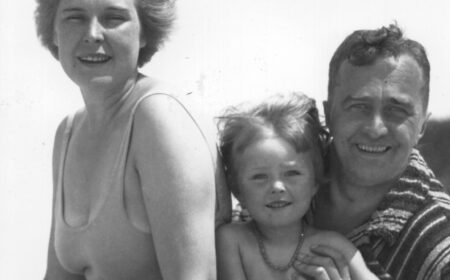
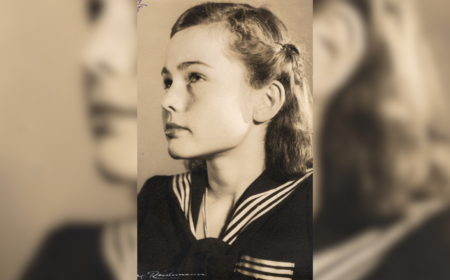
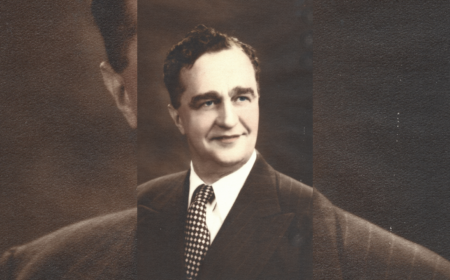
Melissa’s father, Kuno Georg Detlef Foelsch, came from a family that had been living in Estonia for around 300 years, when his ancestors came from Lubeck, Germany.
Kuno was born in 1894 in Tallinn, which was part of the Russian empire then. When World War I broke out, he was conscripted in the Russian Army. When the Russian Civil War erupted, he joined the anti-communist White Russian side, which lost. He was in the army under the command of General Anton Ivanovich Denikin, which was evacuated around 1920 from the Crimea by the Red Cross to Istambul, in Turkey. There he worked for a year peeling potatoes at a restaurant. Melissa recalled in the ADST Oral History, “He was preparing his favorite dish, sort of ground meat with peas and onions and chopped potatoes and I watched him peeling potatoes. I said, ‘How can you peel so fast?’ Potatoes are not easy. Then he told me the story that he peeled potatoes for one year.”
By 1922, Kuno was already enrolled in Braunschweig Technical University in Germany, where he studied and worked in laboratories of that university until 1929, when he obtained his master’s degree in applied physics.
Also in 1929, he married Miliza Korjus, who was starting her singing career with performances in Estonia. Miliza was 15 years younger than him.
He then did research at Braunschweig on thermodynamics and optical measurements in ultraviolet light by photoelectric methods, which were very advanced topics at the time.
The couple lived together for a while in Germany in 1932 and returned to Tallinn in the autumn of that year, when Melissa was born. In the following year, he returned to Braunschweig, where he completed his doctoral thesis on magnetic fields. In 1935, he received his Ph.D. from Braunschweig in theoretical physics, and the following year published his thesis in Archiv für Electrotechnik, a major German electrical engineering journal.
When he moved to Los Angeles in 1936 with Miliza, he did not need to work because of her income from the tremendous success of MGM production The Great Waltz.

He became a US citizen in 1941. In that same year, Miliza and their daughter moved to Mexico.
Sometime before 1943, Kuno and his daughter’s nanny, Emilie (Lia), fell in love. Lia, born in Latvia, had been the nanny when they lived in Germany and immigrated to the US with the family. When Miliza and her daughter moved to Mexico, Lia stayed in Los Angeles. Shortly after Miliza returned to Los Angeles in 1946, she and Kuno divorced.

Starting in 1943, in the middle of World War II, Kuno began working for American aircraft manufacturers, often on secret projects. He worked for Hughes, Aerojet, North American, Oscillojet, Marquardt and other companies as stress analyst or physicist on jet propulsion. The pay was good.
In 1947, he was suddenly dismissed from North American and Marquardt because he had lost his security clearance.
“My father was suddenly dismissed from his well-paying job,” Melissa wrote in a memoir. “He had been working since the beginning of World War II with various companies that had government contracts. He had a Ph.D. In theoretical physics, and master’s degrees in applied physics and mathematics – all degrees from German universities. My father, who had been sought after by employers working in the aeronautical/rocket field, was no longer able to find work with any of these companies. No reason or explanation was given.
Years later, quite by accident, while working at the State Department, I ran across messages citing my uncle in Sweden – my father’s youngest brother – as an East-West trader. Trading with the Soviet Union in those days was definitely a suspicious activity.
Then my father started receiving the unemployment checks of $25 a week for 26 weeks. When that income stopped, we started selling the furniture. On the weekend we would take furniture to Bekins Storage, who ran an auction every Sunday. We kept our fingers crossed during the auction and came home with a little money. Our diet was heavy on noodles, spaghetti and canned tuna. Some friends loaned us small amounts of money.
We were very poor. I remember one Christmas when my father and I went out on Christmas Eve to see if we could buy a tree for change, not bills. We found a scrawny tree and asked how much. The man said one dollar (which was too high a price, but there were only a few trees left). My father said he couldn’t pay that much and started to walk away. The man noticed that I was beginning to cry, and he gave us the tree. At home I decorated this miserable looking tree with all the expensive decorations we had accumulated when we lived in the gorgeous villa my mother had bought in Pacific Palisades when she made The Great Waltz, which had been sold during the divorce proceedings.
Desperate for income, my father heard of an opening for selling vacuum cleaners. He sold a few vacuum cleaners but was not successful. What I did admire was how he must have hidden his hurt pride from being the “Herr Doktor” in German society to being a salesman. Never a word of complaint, but his face and bearing showed the stress and strain he was under. [Note: perhaps the experience of having peeled potatoes helped here.]
At school, in my civics class I learned that Americans had elected officials who served in Congress. I found out that Donald L. Jackson was the representative for the 16th congressional district in California. His office was in the Santa Monica post office. So, I took my father’s little Olympia portable typewriter – which had been the rage in Berlin before we left in 1936 – and typed a letter, explaining my father’s background, his sudden loss of employment and the financial plight we were suffering. My father signed the letter, and I delivered it personally to Congressman Jackson’s office.
Within a week, there was a phone call from Congressman Jackson, and a meeting was set up for my father to meet him. Several weeks later a hearing was set up for my father in downtown Los Angeles. In about a month, my father’s security clearance was restored and he was reemployed. Several months later, my father received a generous financial restitution from the U.S. Government, and we were able to buy a small but very nice house in Pacific Palisades.”
With his security clearance reinstated, he resumed working at aircraft manufacturers until 1958.
He lived in Southern California with Lia until he died in 1965, aged 70.