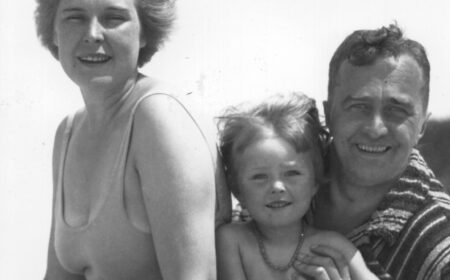
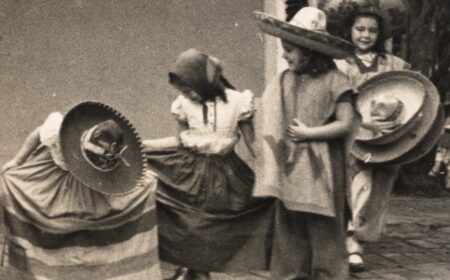
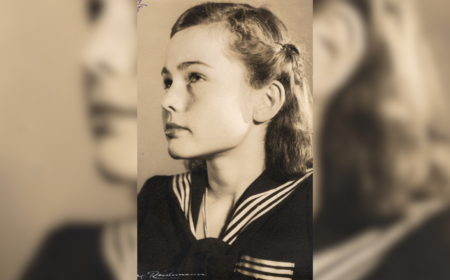
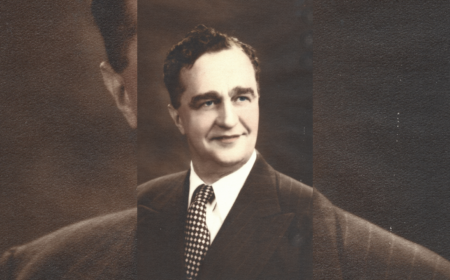
The following text was written around 2018 by Melissa as a memoir.
So off we went back to the USA – to New York City, where my mother’s manager had arranged for a concert at Carnegie Hall and various concert tours. We were quite a gaggle. There was my mother – forever wearing her gorgeous mink coat. . . Just in case of another revolution. There was my brother aged about one year, [and Mexican cook and nursemaid] Carmen, her five-year-old daughter, Concha, and me. My father was in Los Angeles, and apparently too busy working on urgent war contracts. He was to meet us in New York. And so, we took the train. My mother, baby brother and I were in a compartment and the others were nearby. That train took us from Mexico City to St. Louis where we had to change trains.
And that is where the fun started. Unbeknownst to us the World Series was being played in St. Louis and there was not a hotel room to be found. So, we decided to sleep in the station. Of the gaggle, I was the only one, even at age eleven, to have enough smarts to organize us, i.e. find out about lack of hotels and where to be when the next day to go on to New York City.
I must confess that when asking about hotels and being told about World Series, I didn’t know what World Series meant. I did not wish to display my ignorance and just accepted the lack of hotels. Remember, I was raised [in Mexico] on bullfighters and not ball players.
I managed to get hamburgers for my mother, Carmen, her daughter and myself. But Concha had never seen a hamburger and wanted tortillas and tamales. She finally ended up eating sliced bread. But my brother Ernie needed milk. And then a traumatic experience happened that I remember to this day. I walked into a food place, waited in line and then asked for milk. She gave me the milk in a bottle, and I paid and walked away. Then the saleslady started shouting: “Young lady, come back here and pay the deposit!” I didn’t think she was addressing me and kept walking. She kept yelling, screeching and I stopped and turned around. “Pay the deposit!”, she yelled. Tears were welling up in my eyes, as I didn’t understand what she wanted. Just then a soldier sitting nearby got up and told me that she wanted a few pennies for the glass bottle. He took the change from my hand and paid her. I was so grateful to this stranger and thanked him. Strange how strong that memory is even today.
Finally, we reached Manhattan and were met by Charles Wagner, my mother’s manager, and several staff from his office. It took several taxis to carry the gaggle, the welcoming committee – I don’t think Wagner was expecting so many of us – and tons of baggage. Our first abode in Manhattan was to be the Great Northern Hotel on West 56th Street.
Just looking out the cab window, I was so impressed with the tall buildings – the skyscrapers everywhere. I had never seen anything like it. . . and I loved it. And that evening seeing Manhattan lit up gave me such a thrill. Then one of Mr. Wagner’s staff explained the geography of Manhattan – the numbered streets, east and west, divided by avenues named first, second, etc. There were a few exceptions. How brilliant I thought, instead of searching for addresses on streets named after dead people nobody ever heard of.
The Great Northern Hotel no longer exists. But it was across the street from Carnegie Hall. It was also one block away from the Russian Tea Room, which became for my mother and me sort of a second home. As I recall, my mother learned of the Russian Tea Room from her Russian friend Albertina Rasch, who had done all the choreography for the film “The Great Waltz”. In those years it was the meeting place for Russian expatriates, and my mother was feted every time we went. I only heard Russian spoken and the food was delicious – borscht, blinis, stroganoff and more. My favorite dish was a slice from a loaf of flaky pastry filled with salmon or cabbage, always served with sour cream. The staff knew how much I loved this dish, even though I did not know its name. They all called me by my nickname Kiki. It was not until fifty years later I again met up with this dish in Estonia and learned its name – kulebiaka, I hope I have the name right from the Russian.
Meanwhile, for the Mexican contingent of the gaggle, we found a Mexican restaurant called Xochimilco, as I recall, somewhere on West 46th street. We all went there frequently. The staff and owners were Mexican and they treated us royally. On their jukebox, they had all my favorite Jorge Negrete songs, some of which I knew by heart.
And then there was Rumpelmayer’s- now long gone. It was located on the ground floor of the St. Moritz Hotel on Central Park South. My mother always took me there after I had been ice-skating – either at Rockefeller Plaza or the pond near East 72nd street in Central Park – frozen in winter. At Rumpelmayer’s we always had hot chocolate with our pastries. And they had the best hot fudge sundaes – like with melted fudge and not chocolate syrup. When my father visited, we would go to what was then “Germantown” in the east ’80’s. There were many good restaurants serving German cuisine there.
At the hotel we had two double rooms with a large bathroom in between. But it was very cramped, and Mr. Wagner’s office was desperately looking for an apartment for us. But it was wartime and housing was scarce.
My mother’s concert at Carnegie Hall with the New York Philharmonic Symphony Orchestra was a tremendous success with rave reviews. Virgil Thomson of the New York Herald Tribune said: “She has a voice with coloratura work that seems almost unbelievable for beauty of tone, accuracy of pitch, musical rhythm and phrasing and a velocity unknown since the early days of the century.” Shortly after the Carnegie Hall concert, my mother started the concert tours and I always accompanied her as I had in Mexico.
After several months of hotel living, an apartment was finally found on the upper east side, and we moved in. By this time, I was 12 and we had to find a school for me. After what had happened to me with Paul, my mother wanted a school close to where we lived to which I could walk and not take buses and subways. There was a Catholic school two blocks from where we lived. We went there and when asked if we were Catholic, my mother replied that we were.
I started school and on the first day a very embarrassing event took place. Every morning one of the first things we did was pledge allegiance to the flag. I remembered the words from when I was in the Brentwood Town and Country School before going to Mexico. So, after the words “I pledge allegiance. . .”, I took my right hand away from over my heart and extended it straight to the flag. The class broke into titters and giggled. Such a motion was now the Sieg Heil Hitler salute and had been dropped several years ago. Well, you live and learn!
My mother continued with her concert tours, and I merrily went off with her for a week or two. Then I would show up in class again without a note or explanation. This was what I had been doing in Mexico for the previous several years. The teacher would say: “Nice to see you again. Where have you been?”. I would explain that I had accompanied my mother on her concert tour to Montreal and then to Seattle and wherever and tell the class about all the things I had seen and done After two or three of these disappearances, one day I came home from school, and my mother said : “Kiki, we have to talk”. She said that a gentleman had come to see her that morning asking why I was not attending school regularly. She explained that she liked to travel with me and that I was a big help backstage. The man explained that under the law I had to attend school regularly or else bring a note explaining my absence. If I did not attend school regularly, there would be penalties. My mother would have to pay a fine, appear in court, and so on. The two of us had a good cry together. My mother had obviously been visited by a truant officer alerted by the school.
So I started attending school regularly. I was not a good student, getting very low grades. In Mexico I had learned to divide differently, fractions were a complete mystery. American history seemed rather boring what with pilgrims and so on when I had learned about Aztecs and human sacrifice, conquistadores and revolutions. And the Mexican War, I had been taught how the US had stolen about half of what was previously Mexico! So, I decided to work on it and improve my grades. I got tired of having my palms whacked with a ruler along with other kids receiving low marks.
But I decided to really get to know New York City. I was not allowed to go about alone and so Concha, towing my baby brother Ernie, had to go with me. Every weekend we would go exploring. We went everywhere . . . Coney Island, the Bronx Zoo, the Cloisters, museums and sometimes we went to the movies.
Here I have to tell you a story about going to see a film. Concha, Ernie and I bought tickets to see a Frank Sinatra movie. We are sitting in our aisle seats in a very full theatre when Sinatra appears on the screen. The whole theatre starts screaming hysterically – the bobby-soxers – mainly teenage girls reacting to Sinatra. Concha, who was usually sitting on the aisle in case of needing to go change [my brother] Ernie’s diapers, was already running up the aisle yelling “Venga niña, es un incendio”. She thought there was a fire! I had to run after her and explain that this screaming would occur every time Sinatra appeared on the screen. But at least they were quiet when he sang. Concha asked that we not go to anymore Sinatra films.
It was during this period of my life that I understood World War II. In Mexico the war was something I saw in the movies. But in New York listening to the radio, I would get up-to-date news on the battles. I remember following closely the battle of Iwo Jima as it was occurring. I felt the impact of the war in so many ways – the sad popular songs, like “I’ll Walk Alone”. . . the lyrics describing the sorrow of a couple forced apart by the war, friends who had lost loved ones, the purple hearts and gold stars hanging in windows, the shortages – ration books with coupons to buy meat, cooking oil, sugar, leather shoes and other items. The war became real for me, not just something in a film. But then in May and in August of 1945 the war was over, and I thanked God with other millions of people.