
Georgetown University 1955 to 1957
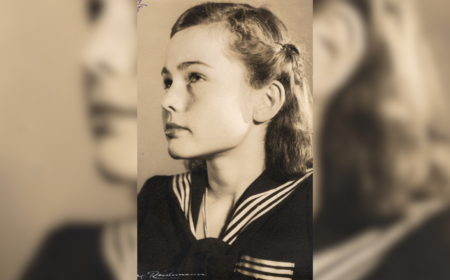
After living in Europe for almost two years, Melissa returned to the US in 1955, going straight to Washington, DC. There she enrolled in Georgetown University’s School of Foreign Service, at the undergraduate level, which was mostly directed at preparing students for diplomatic careers. She had already completed two years at Mount Saint Mary’s College in Los Angeles, so she needed another two years’ worth of credits.
At that time, Georgetown did not accept women for the full-time day school, so she took part-time night classes, paying with money from her father and from what she earned from Elaine Shepard, a journalist, as an au pair, taking care of a young girl. Then she learned that the day school would open for women, but she didn’t have enough money.
Georgetown is a Catholic school run by the Jesuit order. “Father Favner was regent of the school,” recalls Melissa in the ADST oral history website, “I went in to see Father Favner, (…) and I said, “Father, I have very good grades, here they are. I started in January of 1955. Now you’re opening the day school and I need some help and scholarship assistance and I don’t qualify for anything”. The exact words I used were “because I’m not the son of a merchant seaman, I’m not the son of a Latin American diplomat, I’m not the son of whatever. God made me a woman!” He sort of looked at me and I said, “I really, is there some way you could help me because I’ll be going to school here for the next 20 years, it seems.” After about three minutes, I said, “Father, you think there’s a chance you might help me?” Well, I got out of there so fast and I thought, “Well, that’s it.” And then within a very few days I got a very nice letter from him, I still have it, saying that as long as I kept up my what was it, B+ average, whatever it was, I would get 50 per cent scholarship assistance, 50, 75, I think it’s more than that. And then of course I had to pay for my books and so forth. Well, I rushed out and I enrolled in the night school and I enrolled in the day school. The day school didn’t know I was going to the night school, the night school didn’t know I was going to the day school.”
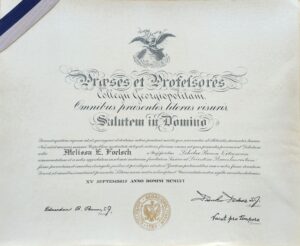
She was the first woman to graduate from the Georgetown School of Foreign Service, and graduated cum laude.
Then she acted on her desire to go to Africa. She applied and received scholarships for a master’s degree in Africa studies at two universities, Northwestern University and Boston University. She chose Northwestern, to study under anthropologist Melville Herskovits, one of the pioneers of African studies at that time. This was before the US State Department had an African Bureau, because most of that continent was still under colonial rule.
“Obviously, that means at that point I was already interested in Africa,” she recalled. “It’s a combination of strange factors, I mean, everything from adventure stories that you hear when you’re young, the films, the movies. As you grow up, you have this sense of exotic almost entirely produced by films and so forth, and you start learning more about it.” One of her favorite movies was King Solomon’s Mines.
Fate, however, would take her on a different route for the time being. She would have to wait twenty years before working in Africa. Instead, she completed a master’s in Latin American studies at Georgetown, paid for in part by the Bolivian Embassy in Washington.
Melissa was invited by Georgetown at least twice to speak there, in 1978 and in 1991, to address the graduating class. As part of the ceremony, the University bestowed her an honorary doctorate. Her advice included these words; “I hope that in your life at this time you have dreams and that you hope to achieve those dreams. I hope that you are taking these dreams seriously and not degrading them with doubts or with an attitude that ‘this too shall pass’. The fact is that a lot of people go through life doing what is safe and not allowing themselves the emotional commitment to a dream. It takes courage – a lot of courage – to keep on renewing your commitment to a dream.”
Her full address may be found here.
In 1994, when working with Sudan issues, one of the graduates from Georgetown approached her and told her how he was inspired by her address. She spoke on a video about this experience.
In October 1997, when she was Consul-General in São Paulo, US President Bill Clinton visited the city, accompanied by Secretary of State Madeleine Albright, who made a point of introducing Melissa to the president. When Melissa mentioned that she had studied at Georgetown, Clinton asked if she had taken classes with Prof. Quigley, Melissa replied, “Yes, and he would read my papers in class as an example of excellent work”.
“He never read any of my papers,” Clinton said. Albright then changed the subject.

Religious views
In 1945, Melissa had a religious experience in the church of St. Jean Baptiste in Manhattan that changed her life forever. From that moment on, she would say in later years, she got to know God. “I became a Catholic on my own when we moved back from Mexico to New York. It was a very, very deep experience. To say it quite openly, I fell in love with God at a very young age, and that’s been a very strong influence in my life ever since,” Melissa told the ADST Oral History website.
She became a devout Catholic and studied in Catholic schools and universities for the rest of her academic life. Her faith guided her actions, her career and relationships until her last days.
Late in life, she wrote to her son Christopher, “As you know, my deep religious experience came about because my mother sent me to a Catholic school because it was only two blocks from where we lived. The stories of saints and the catechism lessons exposed me to ideas, but that powerful gift of faith was knowing and communicating with a Supreme Force called God. As I was learning the ideas, that faith took hold of me deep inside and has never left me. Remember also, that I had had absolutely no exposure to religious thought up until the Catholic school – None!
I consider most religions more than just “clubs” with their special rules. They are trying to learn the reality of The Force, some do a better job than others. Catholicism, in my opinion has gotten the most complete version, but it is still incomplete. And then remember, that all religions have suffered from the frailties of their human leaders.”
In 2002, she took her family to the pew in the church where she had this religious experience.

For the twenty years after she retired in 2001, she lived in a small village, Agulo, in the Canary Islands, next to a Catholic church, which she would visit often.
She was a great fan of paleontologist and Jesuit philosopher Pierre Teilhard de Chardin, who viewed evolution not just as a biological phenomenon but also as a spiritual one. She read all of his books and wrote comments all over them. When in her old age she was no longer able to read, she kept these paperbacks in a special corner, with their dozens of tattered pages marked up from decades earlier.
Her ashes and those of her husband Alfred, who was a Quaker, are buried in a Catholic cemetery, Gate of Heaven, in Maryland, just outside Washington, DC.

The Bolivian Embassy in Washington 1957 to 1958
During the summer of 1957, Melissa got a temporary job substituting the secretary of the Bolivian ambassador to the United States, Victor Andrade, thanks to her fluent Spanish. Just as she was about to leave her job and go study under Professor Herskovits, the creditors of the Bolivian government start attaching (i.e., freezing) the debtors’ “accounts in the United States. “Ambassador Andrade,” she said “immediately, on his own, took over all of the accounts of the Bolivian Central Bank and the government-owned mining corporation, called Corporacion Minera, and put them under the name of the embassy, giving them diplomatic immunity. We had them at Riggs bank, we had them at National Bank of Washington, then and all this money is coming in. He said, “You can’t leave me now. You have to sort this out. If we pay for your graduate studies at Georgetown University in Latin America area studies, will you stay?” I decided to stay. And I gave it up, the Herskovits thing. And I would have been one of the first graduate students out of that program. I finished my Latin American area studies. (…) So, I go to school at night, at the graduate school at Georgetown in Latin America, and they pay my tuition. So, one of the poorest countries in Latin America funded the graduate studies by this ambassador. And I have lovely letters of thanks from the Banco Central, from the Corporacion Minera.”
Victor Andrade and his wife Blanca became good friends and were the godparents of her first child, Christopher, baptized at Trinity Church in Georgetown in 1961. Melissa also kept a friendship with their daughter Lupita.

New York in 1944
The following text was written around 2018 by Melissa as a memoir.
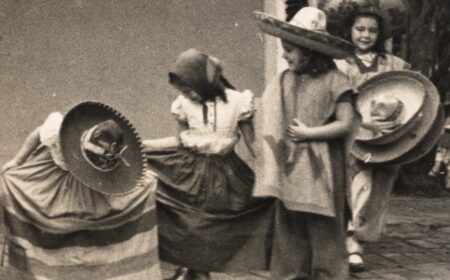
So off we went back to the USA – to New York City, where my mother’s manager had arranged for a concert at Carnegie Hall and various concert tours. We were quite a gaggle. There was my mother – forever wearing her gorgeous mink coat. . . Just in case of another revolution. There was my brother aged about one year, [and Mexican cook and nursemaid] Carmen, her five-year-old daughter, Concha, and me. My father was in Los Angeles, and apparently too busy working on urgent war contracts. He was to meet us in New York. And so, we took the train. My mother, baby brother and I were in a compartment and the others were nearby. That train took us from Mexico City to St. Louis where we had to change trains.
And that is where the fun started. Unbeknownst to us the World Series was being played in St. Louis and there was not a hotel room to be found. So, we decided to sleep in the station. Of the gaggle, I was the only one, even at age eleven, to have enough smarts to organize us, i.e. find out about lack of hotels and where to be when the next day to go on to New York City.
I must confess that when asking about hotels and being told about World Series, I didn’t know what World Series meant. I did not wish to display my ignorance and just accepted the lack of hotels. Remember, I was raised [in Mexico] on bullfighters and not ball players.
I managed to get hamburgers for my mother, Carmen, her daughter and myself. But Concha had never seen a hamburger and wanted tortillas and tamales. She finally ended up eating sliced bread. But my brother Ernie needed milk. And then a traumatic experience happened that I remember to this day. I walked into a food place, waited in line and then asked for milk. She gave me the milk in a bottle, and I paid and walked away. Then the saleslady started shouting: “Young lady, come back here and pay the deposit!” I didn’t think she was addressing me and kept walking. She kept yelling, screeching and I stopped and turned around. “Pay the deposit!”, she yelled. Tears were welling up in my eyes, as I didn’t understand what she wanted. Just then a soldier sitting nearby got up and told me that she wanted a few pennies for the glass bottle. He took the change from my hand and paid her. I was so grateful to this stranger and thanked him. Strange how strong that memory is even today.
Finally, we reached Manhattan and were met by Charles Wagner, my mother’s manager, and several staff from his office. It took several taxis to carry the gaggle, the welcoming committee – I don’t think Wagner was expecting so many of us – and tons of baggage. Our first abode in Manhattan was to be the Great Northern Hotel on West 56th Street.
Just looking out the cab window, I was so impressed with the tall buildings – the skyscrapers everywhere. I had never seen anything like it. . . and I loved it. And that evening seeing Manhattan lit up gave me such a thrill. Then one of Mr. Wagner’s staff explained the geography of Manhattan – the numbered streets, east and west, divided by avenues named first, second, etc. There were a few exceptions. How brilliant I thought, instead of searching for addresses on streets named after dead people nobody ever heard of.
The Great Northern Hotel no longer exists. But it was across the street from Carnegie Hall. It was also one block away from the Russian Tea Room, which became for my mother and me sort of a second home. As I recall, my mother learned of the Russian Tea Room from her Russian friend Albertina Rasch, who had done all the choreography for the film “The Great Waltz”. In those years it was the meeting place for Russian expatriates, and my mother was feted every time we went. I only heard Russian spoken and the food was delicious – borscht, blinis, stroganoff and more. My favorite dish was a slice from a loaf of flaky pastry filled with salmon or cabbage, always served with sour cream. The staff knew how much I loved this dish, even though I did not know its name. They all called me by my nickname Kiki. It was not until fifty years later I again met up with this dish in Estonia and learned its name – kulebiaka, I hope I have the name right from the Russian.
Meanwhile, for the Mexican contingent of the gaggle, we found a Mexican restaurant called Xochimilco, as I recall, somewhere on West 46th street. We all went there frequently. The staff and owners were Mexican and they treated us royally. On their jukebox, they had all my favorite Jorge Negrete songs, some of which I knew by heart.
And then there was Rumpelmayer’s- now long gone. It was located on the ground floor of the St. Moritz Hotel on Central Park South. My mother always took me there after I had been ice-skating – either at Rockefeller Plaza or the pond near East 72nd street in Central Park – frozen in winter. At Rumpelmayer’s we always had hot chocolate with our pastries. And they had the best hot fudge sundaes – like with melted fudge and not chocolate syrup. When my father visited, we would go to what was then “Germantown” in the east ’80’s. There were many good restaurants serving German cuisine there.
At the hotel we had two double rooms with a large bathroom in between. But it was very cramped, and Mr. Wagner’s office was desperately looking for an apartment for us. But it was wartime and housing was scarce.
My mother’s concert at Carnegie Hall with the New York Philharmonic Symphony Orchestra was a tremendous success with rave reviews. Virgil Thomson of the New York Herald Tribune said: “She has a voice with coloratura work that seems almost unbelievable for beauty of tone, accuracy of pitch, musical rhythm and phrasing and a velocity unknown since the early days of the century.” Shortly after the Carnegie Hall concert, my mother started the concert tours and I always accompanied her as I had in Mexico.
After several months of hotel living, an apartment was finally found on the upper east side, and we moved in. By this time, I was 12 and we had to find a school for me. After what had happened to me with Paul, my mother wanted a school close to where we lived to which I could walk and not take buses and subways. There was a Catholic school two blocks from where we lived. We went there and when asked if we were Catholic, my mother replied that we were.
I started school and on the first day a very embarrassing event took place. Every morning one of the first things we did was pledge allegiance to the flag. I remembered the words from when I was in the Brentwood Town and Country School before going to Mexico. So, after the words “I pledge allegiance. . .”, I took my right hand away from over my heart and extended it straight to the flag. The class broke into titters and giggled. Such a motion was now the Sieg Heil Hitler salute and had been dropped several years ago. Well, you live and learn!
My mother continued with her concert tours, and I merrily went off with her for a week or two. Then I would show up in class again without a note or explanation. This was what I had been doing in Mexico for the previous several years. The teacher would say: “Nice to see you again. Where have you been?”. I would explain that I had accompanied my mother on her concert tour to Montreal and then to Seattle and wherever and tell the class about all the things I had seen and done After two or three of these disappearances, one day I came home from school, and my mother said : “Kiki, we have to talk”. She said that a gentleman had come to see her that morning asking why I was not attending school regularly. She explained that she liked to travel with me and that I was a big help backstage. The man explained that under the law I had to attend school regularly or else bring a note explaining my absence. If I did not attend school regularly, there would be penalties. My mother would have to pay a fine, appear in court, and so on. The two of us had a good cry together. My mother had obviously been visited by a truant officer alerted by the school.
So I started attending school regularly. I was not a good student, getting very low grades. In Mexico I had learned to divide differently, fractions were a complete mystery. American history seemed rather boring what with pilgrims and so on when I had learned about Aztecs and human sacrifice, conquistadores and revolutions. And the Mexican War, I had been taught how the US had stolen about half of what was previously Mexico! So, I decided to work on it and improve my grades. I got tired of having my palms whacked with a ruler along with other kids receiving low marks.
But I decided to really get to know New York City. I was not allowed to go about alone and so Concha, towing my baby brother Ernie, had to go with me. Every weekend we would go exploring. We went everywhere . . . Coney Island, the Bronx Zoo, the Cloisters, museums and sometimes we went to the movies.
Here I have to tell you a story about going to see a film. Concha, Ernie and I bought tickets to see a Frank Sinatra movie. We are sitting in our aisle seats in a very full theatre when Sinatra appears on the screen. The whole theatre starts screaming hysterically – the bobby-soxers – mainly teenage girls reacting to Sinatra. Concha, who was usually sitting on the aisle in case of needing to go change [my brother] Ernie’s diapers, was already running up the aisle yelling “Venga niña, es un incendio”. She thought there was a fire! I had to run after her and explain that this screaming would occur every time Sinatra appeared on the screen. But at least they were quiet when he sang. Concha asked that we not go to anymore Sinatra films.
It was during this period of my life that I understood World War II. In Mexico the war was something I saw in the movies. But in New York listening to the radio, I would get up-to-date news on the battles. I remember following closely the battle of Iwo Jima as it was occurring. I felt the impact of the war in so many ways – the sad popular songs, like “I’ll Walk Alone”. . . the lyrics describing the sorrow of a couple forced apart by the war, friends who had lost loved ones, the purple hearts and gold stars hanging in windows, the shortages – ration books with coupons to buy meat, cooking oil, sugar, leather shoes and other items. The war became real for me, not just something in a film. But then in May and in August of 1945 the war was over, and I thanked God with other millions of people.
Early Life in Germany 1933 to 1936
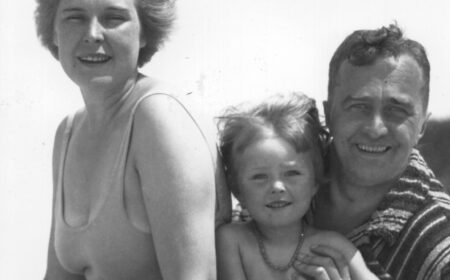
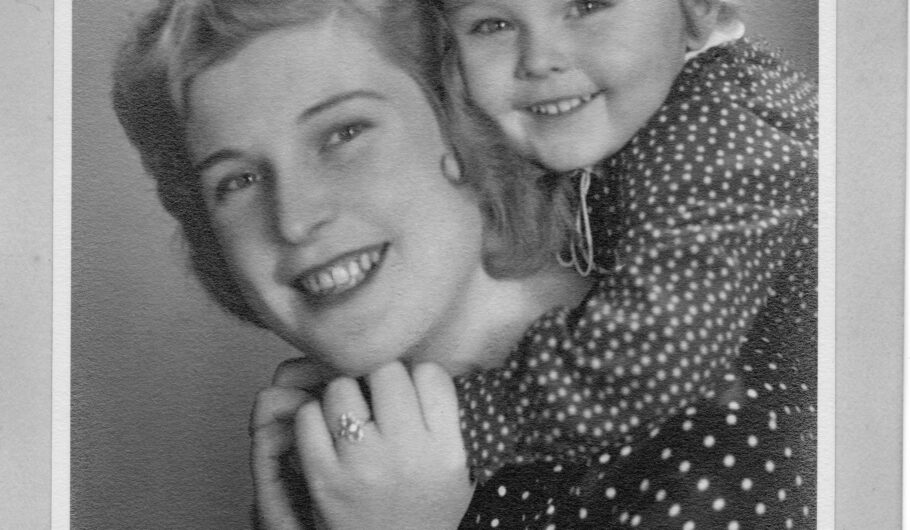
Melissa, then Miliza-Elisabeth Foelsch, lived in Germany from age one to four (1933 to 1936) with her parents, Miliza Korjus and Kuno Foelsch. She had a nanny, Lia, who was born in Latvia. They spoke German at home. They probably lived during this entire period in Berlin.
Both parents were brilliant in their very different fields of expertise.
Her mother was a soloist at the Magdeburg Opera Theater for the 1933/34 season. She performed with very popular reviews in Berlin, Cologne, Vienna, Warsaw, Budapest, Zurich and other cities. In 1934, the German recording company Electrola began selling vinyl records of Miliza Korjus’ singing works by major composers. In 1935, a German horror movie, The Student of Prague, featured Miliza singing two songs.
Melissa would sometimes appear in promotional photos with her mother.


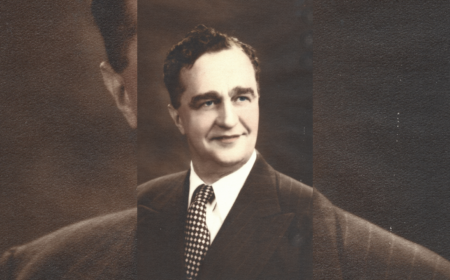
Melissa’s father continued his scientific studies. He worked on his doctoral thesis on magnetic fields. In 1935, he received his Ph.D. in theoretical physics, and the following year published his thesis in Archiv für Electrotechnik, a major German electrical engineering journal.
One night, after Miliza Korjus performed at the Berlin opera, she received a telegram from renowned Hollywood film producer Irving Thalberg saying that he wanted her to be the lead singer in a major film production at Metro-Goldwyn-Mayer (MGM) studios. Negotiations went back and forth for a few weeks, and she agreed.
When she sang at her last concert in Berlin, Miliza knew she was on her way to Hollywood.
In mid-1936, Miliza, Kuno, their daughter and the nanny Lia immigrated to the United States.
For a video of Melissa speaking German, click here.
For more information about Miliza Korjus, click here.

Joining the Foreign Service in Washington 1958 to 1961
Melissa took the US Foreign Service exam three times. “First time I took it, I was bowled over,” said in her ADST oral history. I’d never seen an exam like this. I never covered the territory. I got a terrible grade. Then it came up again, and I took it, and I missed by one point. I became better at learning how to take the exam. Now, most of the kids learn how to take the exam but we didn’t do that in those days. So then when I took it for the third time, I got a very good grade. Then I was called fairly early for my oral examination.”
The oral examination lasted two hours. There was an unwritten rule that Foreign Service women, once they married another US diplomat, would move with their husband and resign. “In those days, all women taking the exam were prepared for the inevitable question, which is never asked nowadays, ‘Miss X, what are your marriage plans?’ If you say, ‘I would like to get married sometime’ but then they say ‘You can’t combine a career with marriage. Don’t waste our time.’ My ploy was I was going to try to make them laugh and drop the subject and move on to something else. So about five minutes into the exam. ‘Miss Foelsch, may I ask, what are your marriage plans?’ I had rehearsed this carefully. It helps to be on stage. ‘I’m nearly six feet tall and I weigh two pounds more than Sugar Ray Robinson (a famous boxer) and I just can’t find the right guy.’ And they laughed. It’s a stupid answer.”
In her written application, she made it clear that she was aware of the Foreign Service’s policy on women marrying – even though it was never on paper. Her application also showed how she had financed her own life with little help from her parents. She had an idea of what life was like in the Foreign Service thanks to press reports and a booklet published in 1955.
Melissa Foelsch joined the US Foreign Service on September 11, 1958.

A photo of the people joining the Foreign Service that year shows that she was the only woman. There is another woman in the photo, who was the secretary of the training course. Melissa wrote on the photo: “As of 1992, I outlasted and outrank all of them.”

Her first assignment was in Intelligence and Research, INR, as an analyst. “We used to have duty that would rotate. The most junior officers of the incoming class would take on the early morning briefing, which meant getting to the State Department building in downtown Washington by six o’clock in the morning or something like that, reading the cables, and then having it all battened down to give a briefing at eight o’clock, eight-thirty. This meant, of course, being out on the streets by five-thirty, five-fifteen or so! Unbeknownst to me, my male colleagues of the same rank got together and said, ‘Let’s spare Melissa this job.’”
Her male colleagues wanted that I need not get up and take the risk –they knew I didn’t have a car–getting to the Department by six o’clock. “So they said, ‘We’ll just rotate. We’ll spare Melissa this.’ But at the same time, they were keeping me from a very interesting aspect of my job!
But you see, I cannot in any way say that it was anything but well-intended. I found out about this, because two or three rounds went by and I said, ‘Hello? When’s my turn?’
They said, ‘Look, we talked to the boss.’
‘No way!’ Then I had to pull my way into this thing,” she recalled.
On April 1st of each year, each Foreign Service Officer was asked to fill out a form indicating what their first choice for a post would be. For the first two years, Melissa put Elisabethville (now Lubumbashi) in what is now the Democratic Republic of Congo. Her dream would come true thirty years later when she was posted to Kinshasa, the capital of that country – and had to close that consulate.
Shortly after joining the Foreign Service, Melissa met her future husband, Alfred Wells, who was 16 years older than her and had joined the Foreign Service in 1941. He had been married and had a nine-year-old daughter, Gully who was living in London. Alfred and Melissa quickly fell in love.

When Melissa knew she was pregnant, they announced their engagement in the New York Herald Tribune on May 7, 1960, and married in mid-1960 in Los Angeles. Their first son, Christopher, was born in December of that year.

A few months later, however, the couple had a major falling out and got divorced. Alfred moved to the US Embassy in London. With this dramatic separation, Melissa became the Foreign Service’s first single mother, a situation that its human resources department had never faced. That unwritten rule about married women leaving didn’t cover her predicament.
“After about two weeks, I was at work and my phone rang,” Melissa wrote in a memoir. “I answered and the caller identified himself as John Jova. Everyone knew that name – he was the chief of personnel operations! I swallowed hard, didn’t know what to expect. ‘Mrs. Wells, I hear you are interested in a foreign assignment. Where would you like to go?’ I almost fell out of my chair! I was an FSO-8, the lowest rank of Foreign Service Officer, being asked where I would like to be assigned?!
I collected my wits and explained that I had a very young son and needed a healthy post and one where I could afford help to look after my son. Jova apparently was looking at a list and suggested Trieste. I replied that I spoke Italian and that would be great. Then Jova said: ‘No, how about Trinidad, that might be better?’ I readily agreed.”
So, Melissa, who spoke German, Spanish and Italian, was sent to a post where they speak English.
Milan 1954
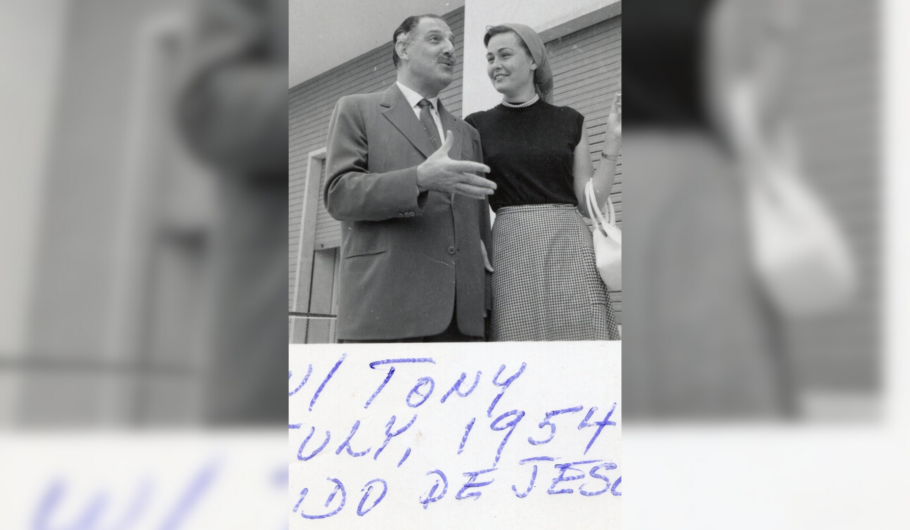
During the Aqua Parade water ballet in late 1953, Melissa started having dinners with the manager of the tour, an Italian by the nickname of Tonino (no full name is available). He spoke no English and was 22 years older. “My Italian improved quickly because I knew Spanish having been raised in Mexico,” she wrote in a memoir in 2017, “but I was hardly fluent. Tonino had traveled all over Italy, and he would tell me about different parts of the country. He told me about the Mussolini years and about having been drafted to fight in Ethiopia. I liked him a great deal and I sensed that he was attracted to me.”
Tonino was very understanding of the sexual abuse that she had suffered as a child (she had never told anyone other than her mother). He was her first real experience of having a boyfriend. When the Aqua Parade tour went bankrupt, they lived together in Milan all of 1954.
She worked in the city for the whole time in two jobs after the water ballet flopped.
One habit that she adopted was using her hands as she talked in Italian, which she learned quickly. She probably had already gotten used to this when she lived as a child in Mexico. For the rest of her life, she would gesture with her hands when speaking in any language.

She got her first driving license and was taught by Tonino and others to honk the car horn frequently as she was driving. She did not adopt this habit.
One night, when she was walking alone in Rome near the Victor Emmanuel II National Monument, also known as the Vittoriano, she was being followed by a suspicious man. She sought help from the traffic policeman who was working on an “island” in the middle of the traffic. She asked him to do something about this stranger. The traffic cop replied, “If I didn’t have to do what I’m doing now, I’d be doing what that man is doing.” The suspicious man, not knowing what the cop had said, went away and Melissa carried on safely.
Her relationship with Tonino, which had started off very well, became strained as he became increasingly jealous.
Melissa, in a memoir, wrote about the change in her personality that took place over that year. “I cannot define the reason why or how, but it seemed that since achieving my sexual maturity, I had developed steel in my spine,” she wrote. “Gone was that little voice that I often had heard within me saying: ‘I shouldn’t’ or ‘I can’t’. What I am writing here is (…) a recognition of a change in my personality. One example is how I ended my relationship with Tonino.
One evening after another of the jealous outbursts, I was really annoyed as we returned to our small apartment. Tonino kept on with his tirade, and I felt anger rising within me. I happened to be standing by the wash basin in the bathroom with a row of bottles on the shelf above the basin in front of me. I started yelling at him – first time ever. I thought of taking his bottle of Atkinson’s lavender cologne and throwing it at him across the room. A little voice inside said, ‘I bet you won’t do it’. It was like a taunt. . . and I threw it! He stopped yelling and looked thunderstruck. But I so enjoyed throwing that bottle, that I threw at him his Pantene hair lotion and then his Botot mouthwash! It felt terrific and he ran out of the room and did not return that night.
The next day when I saw him, I told him that I was leaving him and that he would never hear from me again. A few days later I was on my way back to the USA and began a new life full of adventure and much happiness.”
In January 1955 she took a ship back to the US and began fulfilling her dream of attending Georgetown University.

Trinidad & Tobago 1961 to 1964
The US government sent Melissa and her nine-month-old son to her first overseas post a cheap way: on a freighter. The SS Managua, which belonged to Nicaraguan dictator Anastasio Somoza, set sail from Baltimore with stops in Maracaibo, Venezuela, and Georgetown, Guyana, before arriving in October 1961 at Port of Spain, Trinidad. Melissa and Christopher were the only passengers with the rest of the cargo being minerals.
Trinidad & Tobago would become independent from the United Kingdom in the following year. The US was setting up a new embassy in Port of Spain and Melissa worked as a vice-consul in the visa section.
The US magazine Ebony, which promotes the cause of the Black American community, had a picture of her processing visas together with a Black US diplomat in Port of Spain, presumably her boss.
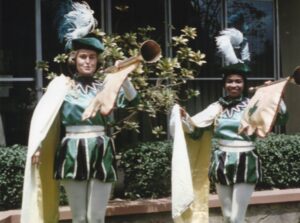
Carnival, with its costumes and dancing, greatly interested Melissa. She joined one of the bands in the Carnival of 1963. By another coincidence, a local magazine, Caribbean Beachcomber, carried a photo of her in Carnival after she had left in 1964.
Melissa had fond memories of being a single mother starting out her career in a tropical climate. She would go to the beach on the weekends with her son Christopher or take him to the pool in the Hilton hotel. She hired a nanny, Elvira, and invited her aunt Trudy, who lived in Germany, to stay with her to help take care of the boy.
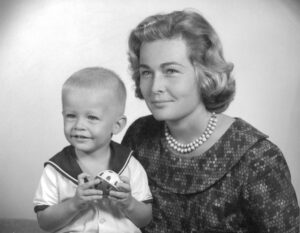
Melissa had recently divorced her husband Alfred, who had been stationed at the US embassy in London. They exchanged letters and he came twice to visit her. By the time she left Trinidad, they were back together again, although they never remarried. They would live together, considered married under common law, until he died in 2014 at 98 years of age.
Prior to their getting back together, Melissa took a trip with Christopher to Grenada and a little island she saw on the map, Carriacou. When she arrived on Carriacou, she immediately fell in love with the island and bought a plot of land on a hill next to a cemetery – her first real estate purchase. This was the beginning of a relationship that her family had with that lovely island that lasted for decades.
In 1963, Melissa was transferred to Paris, much closer to Alfred. It is not known whether the State Department took this factor into account.
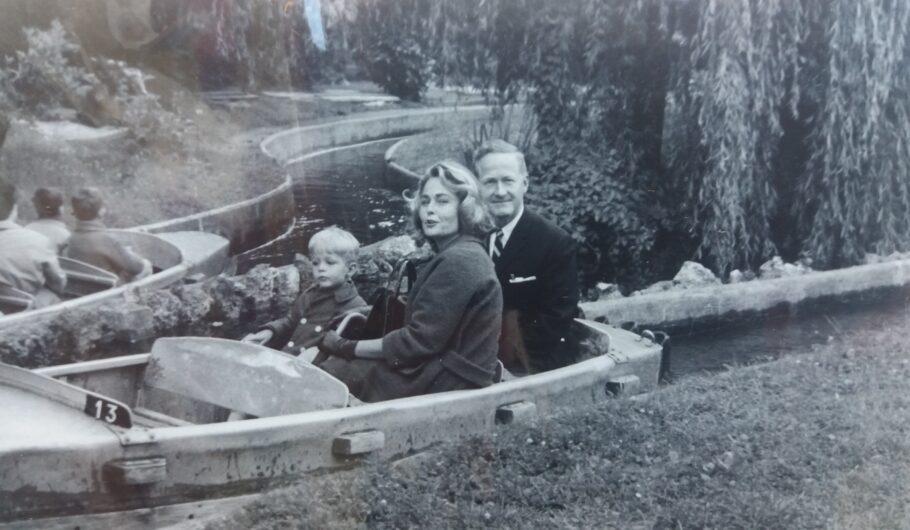
Paris 1964 to 1966
Melissa was transferred from Port of Spain to Paris, where she was an Economic Officer at the U.S. Mission to the Organization for Economic Cooperation and Development (OECD), an international entity then composed of developed countries. The OECD’s headquarters is in Paris. Her focus was monitoring the creation of the European Common Market, a predecessor of the European Union.
With this move, she was now much closer to Alfred, whom she had divorced, got back together again and who was stationed in London. They would visit each other on the weekends and she described this period as one of the most romantic in her life. She conceived her second son, Gregory, who was born in 1996 in London.
Guinea-Bissau 1976 to 1977
Guinea-Bissau gained its independence from Portugal in 1974, after a long guerrilla war. Cape Verde’s independence came in 1975, also from Portugal. In 1976, Melissa was named the first US ambassador to both countries, which were ruled by the same political party, the Partido Africano da Independência da Guiné e Cabo Verde (PAIGC).
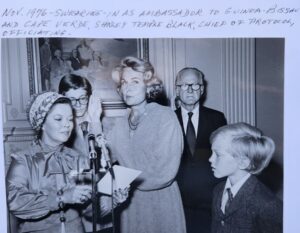
Melissa was sworn in as Ambassador in Washington in a ceremony attended by her family and authorities from the two countries. This would be her first of four swearing-ins, always at the State Department building and always with her family present. Shirley Temple Black, who used to be a famous actress when she was a child, was the official in charge of the swearing-in. Larry Eagleburger, the acting US Secretary of State, joked that, thanks to Melissa’s excellent swimming abilities, the government would save on travel between Cape Verde and Guinea-Bissau.
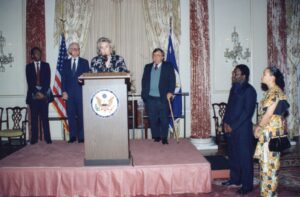
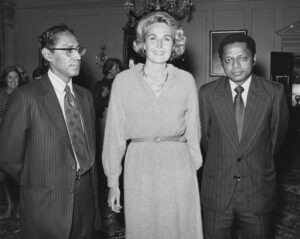
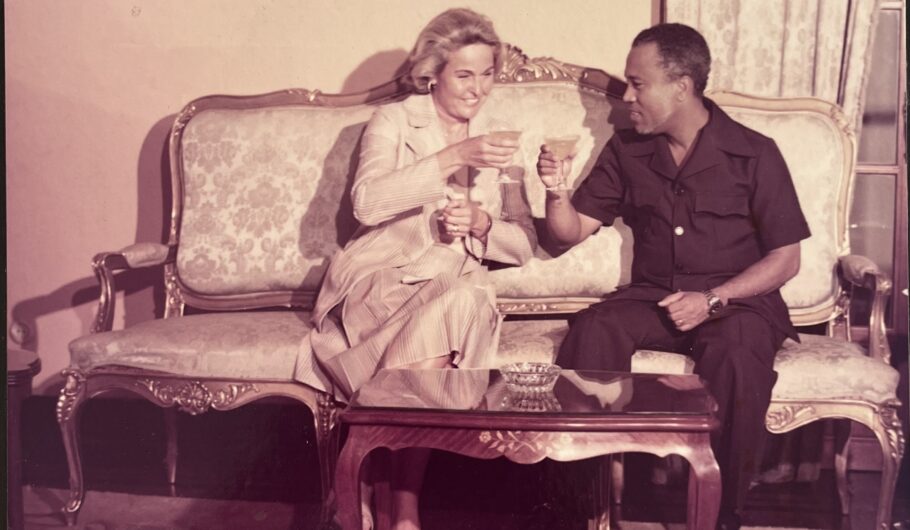
When she arrived in Bissau, she presented her credentials as ambassador for the first time. This was to Guinea-Bissau President Luis Cabral, half-brother of the liberation hero Amilcar Cabral.
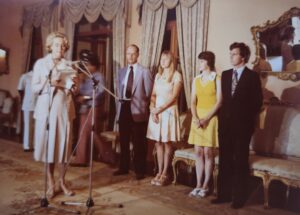
Melissa had rudimentary living accommodations and working spaces in Bissau, which was the main base for operating in both countries. Melissa, as with many other diplomats, lived in what used to be the Portuguese Army officers’ quarters, a motel-like strip of rooms near a cafeteria. “All the rooms were the same,” she explained, according to the ADST Oral History website. “There was a little sitting room, a tiny little thing, a bedroom, and then a bath. Then a little pathway out in the road going up and down this place. I lived there, the Cuban ambassador lived there, and [other ambassadors] lived there. We were all over the place. The cars would come with their little flags and things, rather cute.” Each ambassador was waiting for a house to become available and into which to move.
The embassy’s first office in Bissau was not much better. “My office, for security reasons, had no windows. In Bissau, the electricity was going out fifteen times a day; no electricity, no air conditioning, no lights. The phones don’t work. You just must get used to it. On the bookcase I had a candle and matches.”
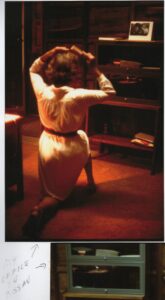
“In Bissau, the electricity was off more than it was on,” recalls a colleague who worked at the Embassy. “Hours would go by with no electricity which meant no air conditioning (windows couldn’t be opened for security reasons), no lights and no water (because the pump wouldn’t work without electricity). Only one phone worked in the entire Embassy and luckily it was the receptionist’s phone, so at least he could receive calls from the Government offices. Sometimes the Ambassador had to speak on the phone with someone from the President’s office while standing in the Embassy’s lobby area. The Embassy’s only means of communications with neighboring Embassies was via shortwave radio.”
There was also a food shortage in Bissau so the Embassy staff arranged to have a local restaurant prepare lunch every day them. The menu varied slightly but there was always rice and goat meat. Other days they were treated to some sort of seafood whether it was prawns, lobster, octopus, oysters, or sometimes barnacles, and even hummingbirds (which he only served once because no one ate them). Whatever else the restaurant owner could find, they were just happy to have a meal.
Her younger son Gregory, who was ten, received schooling from two sources. Melissa’s husband Alfred gave him lessons using the Calvert home school materials. Gregory also attended the local Guinean school. In line with the government’s Marxist ideology, the schoolchildren had to go into the country and do physical work, called trabalho produtivo or productive labor, such as digging a ditch. Gregory loved doing this. One day, Melissa visited his class and saw the teacher reprimanding many of the Guinean students, who were resisting this work. “Why don’t you work hard like this American boy?” he asked of the children, as they leaned on their shovels.
“In Bissau in those days,” Melissa said in her ADST Oral History, “you would frequently see monkeys for sale by the road. And, of course, Gregory wanted a monkey. So, [that meant] a cage for the monkey and one more tenant in our motel quarters. Then, a few days later, he learned – not from me, I assure you! – that these monkeys, they were small monkeys and rather cute, were being sold as food – they cook and eat the monkeys.
Well, you can imagine how upset Gregory became! He was so upset, crying and angry, and rational explanations about differences in culture were to no avail. So, we had to buy every monkey that we saw being sold! Between the one gerbil and the monkeys, I think we had a total of five cages in our small living room,” recounted Melissa.
A few months after arriving in Bissau, she was invited in February 1977 to go to Lagos, Nigeria, and meet Andrew Young, who had been named by President Jimmy Carter as ambassador to the UN. Young invited her to work with him at the US mission to the UN (USUN), to be the ambassador to the UN Economic and Social Council (ECOSOC). “I told him that I thought it was dreadful to run off from my post after having just arrived,” she wrote years later. “We had just started the important negotiations of a USAID, the US aid agency, agreement with each country – Cape Verde and Guinea-Bissau. (…) I was invited to every event Andy had in Lagos – lunches, speeches, meetings and dinners. The night before I was to fly back home, I talked to Andy again and told him I would like to change my mind and work with him. But that first I had to conclude some important business with the two little countries I was accredited to. Andy said ‘Take all the time you need. The job is yours’.”
Gregory was not at all pleased with having to leave Bissau. He loved his school and his monkeys. It was only after he met Andy and his son Bo that he was won over to the idea of moving to New York.