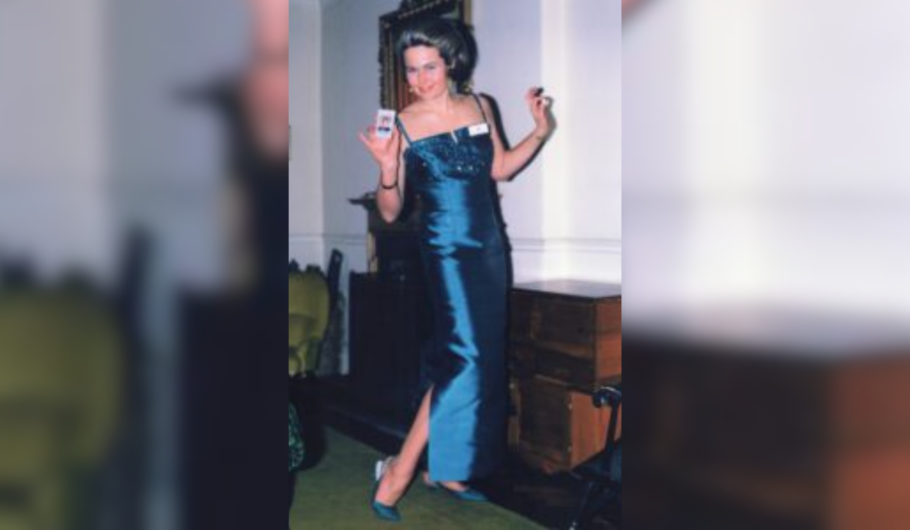
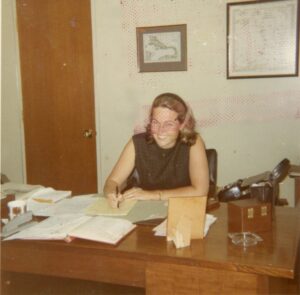
London 1966 to 1970
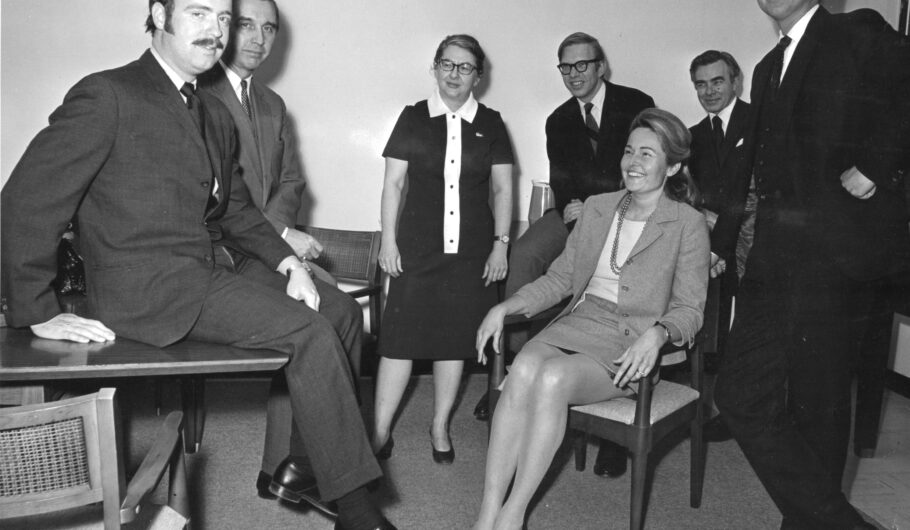
Following Melissa’s work in Paris on the European Common Market, the US State Department wanted to have her transferred to the Embassy in London, where there was an opening for a similar position. Due to the unwritten rule that husbands and wives couldn’t serve in the same post, there was resistance.
Her boss in London, Arthur Hartman, wrote many years later in a letter, “When I chose Melissa to serve with me in the Economic Section in London, I knew not only of her competence, but also that that transfer would finally break the barrier of husband and wife serving at the same post. That stupid ‘rule’ or ‘practice’ had in fact condemned women Foreign Service Officers to stay unmarried or leave the Service. Today people can’t remember the stupidity at all and we encourage (…) what are called ‘tandem couples’. Well, Melissa is the lady who broke that barrier and did it through skill, fortitude and unfailing good humor.’
Alfred resigned in 1966 from the Foreign Service after completing 25 years. He went on to study tropical architecture at the Architectural Association (AA) School of Architecture in London.
Once Alfred had retired, Melissa discovered that the amount paid by the State Department as a family allowance dropped dramatically because there had been no provision for family allowances for women. She explained this to the ambassador, David Bruce, who agreed that the rule should be changed. And it was.
When she moved from Paris to London, she was pregnant with her second son, Gregory, who was due to be born in mid-November. At that time, there was no maternity leave. She was under strong pressure to be back at work before Christmas so that her male colleagues could go on skiing trips. Years afterwards, Alfred would comment in private on how depressed she was in the early months of 1967.
Melissa Wells became the first female US diplomat to have a baby while at an overseas post.
She wrote about the UK economy and occasionally came out in the US press.
Melissa went at least twice to Buckingham Palace. Once was to accompany the Apollo 11 astronauts on a visit to Queen Elizabeth II and deliver a rock from the Moon to Prince Edward (age six), the youngest child of the queen. This was a gift that the US government reserved for special friends. Many years later, she watched the Netflix episode of The Crown about this visit and commented that the actual visit was very different.
During this period, there were several protests in London against the US involvement in the Vietnam War, often in front of the US embassy on Grosvenor Square, where she worked. On one protest in 1968, Melissa remembers watching the protests from inside the building. She greatly admired the discipline and bravery of the bobbies (the British police), who formed two human chains around the embassy, with arms locked between each policeman. “The protesters would spit at the bobbies and kick them in the groin, and the bobbies would hold firm for what seemed like hours, not reacting,” she said in awe. The bobbies held the line and no protesters entered the embassy. (Alfred, who was studying architecture, had been invited by his fellow students to go to the protests. He politely declined.)

Swimming through life
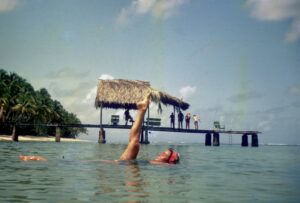
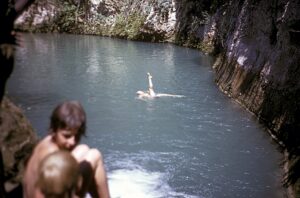
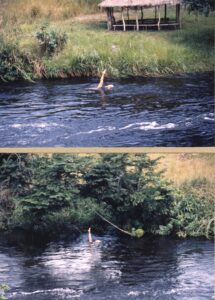
Melissa remained an excellent swimmer for most of her adult life and was able to do a ballet leg, a stunt in water ballet, for many years. Here are photos of her in Trinidad, Haiti and Zaire/Congo (the last one as ambassador in 1991).
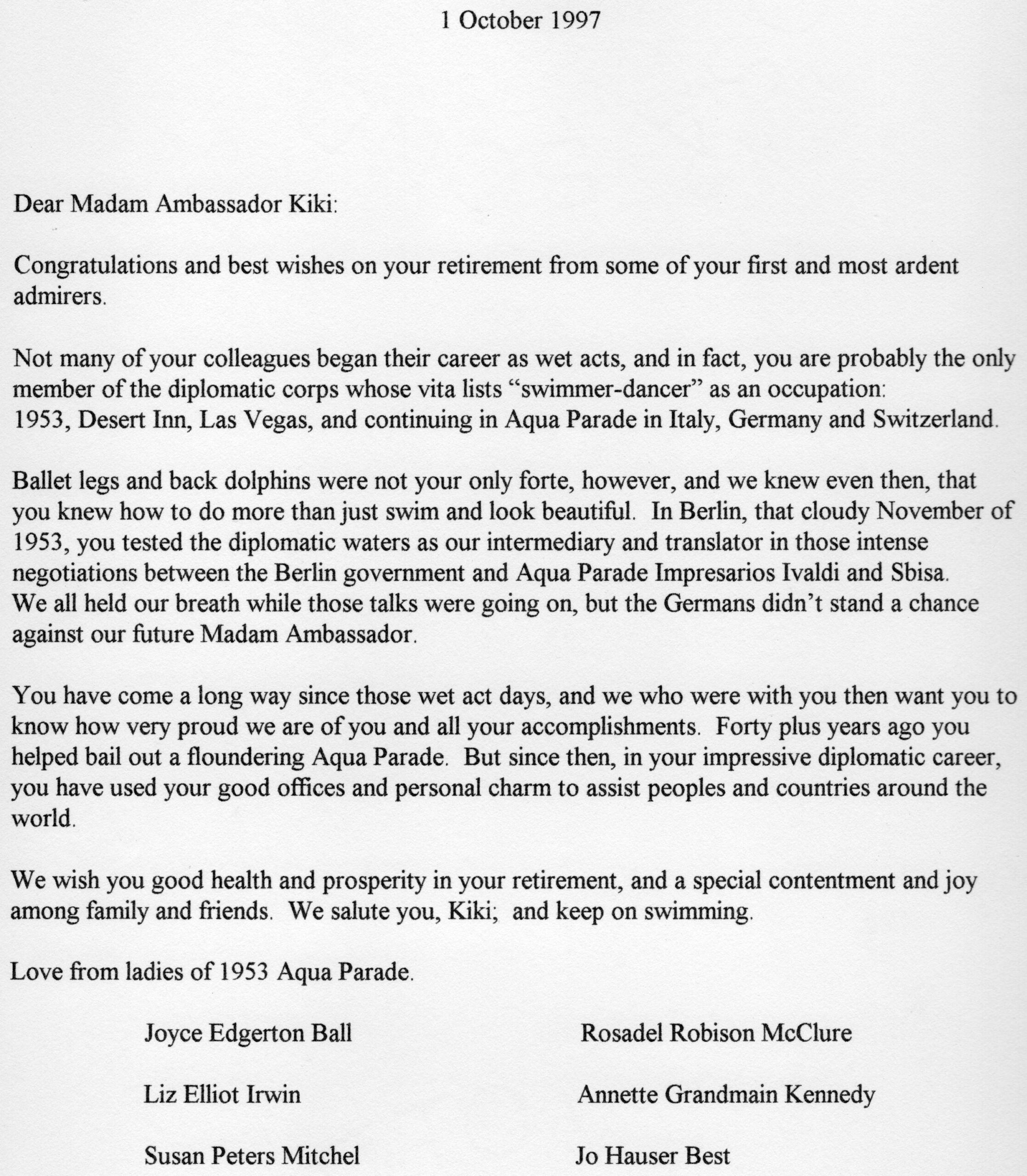
She maintained contact with her Aqua Parade friends for the rest of her life. When she was planning on retiring in 1997, they sent her a letter of congratulations.

Carriacou
In 1962, Melissa took her one-year-old son on a trip to Grenada and Carriacou. She immediately fell in love with the island and, after a few days there, bought a plot of land with no building on it, next to the cemetery. It was her first real estate purchase. She had no money or husband to develop the plot of land yet she dreamt of doing big things with it.
The following year, she took Alfred, from whom she had divorced and got back together, to get to know the island, without telling him about the purchase. One evening when they were swimming off the beach in front of the Mermaid Tavern, she told him. “You did what?”, he exclaimed, “You should have bought stock in Xerox!”


In 1966, Alfred retired from the Foreign Service and began studying tropical architecture. In 1967, he built a wooden cubical shack on a concrete base containing the water supply. The family would spend vacations in this shack.

In 1975, Alfred led a team of local workmen to erect a house that did not need air conditioning and could withstand hurricanes. The house still stands today and survived all the hurricanes that have hit Carriacou, even terrible Beryl in 2024.
In 1983, the US military attacked Grenada. A week later, US Marines waded ashore on Carriacou’s beaches, as young girls offered them flowers. There was no fighting. The Marines drove to where they knew an arms cache had been hidden, across the road from the house and shack. The soldiers detonated what they found, and the blast blew away the shack. The Department of Defense compensated the Wellses for the lost cube.
Both Melissa and Alfred became well-known and -loved people on the island. They would hire local workmen to fix things, then invite them over for rum punches, the local drink made with jackiron, a rum so strong that the ice would sink in it.
In the early 2000s, they were so attached to the island that they planned on being buried in the adjacent cemetery, but then a more practical solution was chosen. Over the years, Melissa often teased Alfred about buying stock in Xerox. He passed away in 2014.
In 2019, Melissa sold the house to a lovely couple that is fully enjoying it. In 2023, her grandson visited the house and made Brazilian caipirinha drinks for them. Her big dreams had come true.

Dinner with a College Freshman
Oscar was the roommate of Melissa’s older son, Christopher, in college in New York. He came from a Mexican American family in a poor neighborhood of El Paso, Texas. He and Christopher would trade stories about their very different backgrounds. One day Christopher said that she would like to meet him on one of her visits to New York. Melissa took time out of her busy schedule one evening in 1980 to get to know this man – one on one.
Here is Oscar’s recounting of the encounter, which both would cherish for years.
“Chris was my roommate during my first year at Columbia University. After a while, he wanted me to meet his mom. Rather, he said his mom wanted to meet me. Which was intimidating. His mom, Melissa Wells, worked as a U.S. ambassador and had an office in the United Nations. Chris talked about his family traveling the world, especially Africa, and knowing people like Andrew Young, then the U.S. Ambassador to the United Nations, and Shirley Temple Black, U.S. Ambassador to Guinea-Bissau. It was a rarefied existence that was alien to me, but I found its unfamiliarity also intriguing.
My background included all manner of eccentrics and local (very local) cultural luminaries, but I knew no one who dined with world leaders and who maneuvered effortlessly through diplomatic circles. I was raised on Kool-Aid and tacos, not champaign and caviar. I was out of my depth. But I eventually gave in, and a date and time were set, except it would only be me and not Chris meeting Ambassador Wells for dinner. I don’t know why Chris insisted that I fly solo or why I agreed. I had nothing to wear, but I probably ironed those nothing clothes to the best of my abilities, perhaps invested in a haircut.
I showed up to the designated restaurant near the United Nations on a rainy afternoon, a small Japanese restaurant, one of those teppanyaki restaurants [Note: probably Benihana] where the chefs double-dazzle through their cutting skills and culinary talents. I had never eaten Japanese. I wasn’t late, but Ms. Wells was waiting for me inside.
Our time together is a blur. I was so mesmerized by the Ambassador that I hardly noticed the twirling butcher knives above a hot griddle just inches from our faces. I had never been treated with greater kindness and grace. I have never known such kindness and grace since. There I was, a poor student totally lacking in social graces and with little of interest to offer a fabulously worldly person, but Ambassador Wells made me feel like the most important person on earth. Indeed, the only person on earth. Her attention never strayed from our conversations. Her light and smile never diminished. She asked polite but genuine, welcoming questions. I was stunned. It turned out I wasn’t here to give her the opportunity to size me up. I was here because she wanted to welcome me into her family’s circle of loved ones.
That is the only time I met with Melissa Wells but once was enough to sustain me through today. I do not know her record as a diplomat, but she changed at least one young life for the better.”

The Bolivian Embassy in Washington 1957 to 1958
During the summer of 1957, Melissa got a temporary job substituting the secretary of the Bolivian ambassador to the United States, Victor Andrade, thanks to her fluent Spanish. Just as she was about to leave her job and go study under Professor Herskovits, the creditors of the Bolivian government start attaching (i.e., freezing) the debtors’ “accounts in the United States. “Ambassador Andrade,” she said “immediately, on his own, took over all of the accounts of the Bolivian Central Bank and the government-owned mining corporation, called Corporacion Minera, and put them under the name of the embassy, giving them diplomatic immunity. We had them at Riggs bank, we had them at National Bank of Washington, then and all this money is coming in. He said, “You can’t leave me now. You have to sort this out. If we pay for your graduate studies at Georgetown University in Latin America area studies, will you stay?” I decided to stay. And I gave it up, the Herskovits thing. And I would have been one of the first graduate students out of that program. I finished my Latin American area studies. (…) So, I go to school at night, at the graduate school at Georgetown in Latin America, and they pay my tuition. So, one of the poorest countries in Latin America funded the graduate studies by this ambassador. And I have lovely letters of thanks from the Banco Central, from the Corporacion Minera.”
Victor Andrade and his wife Blanca became good friends and were the godparents of her first child, Christopher, baptized at Trinity Church in Georgetown in 1961. Melissa also kept a friendship with their daughter Lupita.
Carriacou
In 1962, Melissa took her one-year-old son on a trip to Grenada and Carriacou. She immediately fell in love with the island and, after a few days there, bought a plot of land with no building on it, next to the cemetery. It was her first real estate purchase. She had no money or husband to develop the plot of land yet she dreamt of doing big things with it.
The following year, she took Alfred, from whom she had divorced and got back together, to get to know the island, without telling him about the purchase. One evening when they were swimming off the beach in front of the Mermaid Tavern, she told him. “You did what?”, he exclaimed, “You should have bought stock in Xerox!”
In 1966, Alfred retired from the Foreign Service and began studying tropical architecture. In 1967, he built a wooden cubical shack on a concrete base containing the water supply. The family would spend vacations in this shack.
In 1975, Alfred led a team of local workmen to erect a house that did not need air conditioning and could withstand hurricanes. The house still stands today and survived all the hurricanes that have hit Carriacou, even terrible Beryl in 2024.
In 1983, the US military attacked Grenada. A week later, US Marines waded ashore on Carriacou’s beaches, as young girls offered them flowers. There was no fighting. The Marines drove to where they knew an arms cache had been hidden, across the road from the house and shack. The soldiers detonated what they found, and the blast blew away the shack. The Department of Defense compensated the Wellses for the lost cube.
Both Melissa and Alfred became well-known and -loved people on the island. They would hire local workmen to fix things, then invite them over for rum punches, the local drink made with jackiron, a rum so strong that the ice would sink in it.
In the early 2000s, they were so attached to the island that they planned on being buried in the adjacent cemetery, but then a more practical solution was chosen. Over the years, Melissa often teased Alfred about buying stock in Xerox. He passed away in 2014.
In 2019, Melissa sold the house to a lovely couple that is fully enjoying it. In 2023, her grandson visited the house and made Brazilian caipirinha drinks for them. Her big dreams had come true.

Agulo
In mid-1969, the Wells family was taking a vacation in a VW kombi through the Canary Islands. When they were touring the island of La Gomera, one of the smaller and least developed of the archipelago, they arrived in the town of Agulo (pop. 1,000). They were charmed by the many old, white-washed buildings from the 1800s, in poor condition. Melissa asked a lady if any of these houses were for sale. “The entire town has houses for sale!” the lady answered waving her hands, “All the men have gone to work on the oil fields in Venezuela.”
Alfred and Melissa bought three adjacent houses that had an excellent view of another island, Tenerife. One of the houses had an oven that baked the bread for the town. Alfred had the top of the oven removed, had it painted blue and transformed it into La Gomera’s first swimming pool – before any hotel had one.
When Melissa retired in 2001, the couple moved to Agulo thinking they would spend about a year and then move back to the US. They were so enchanted by the easy life in Agulo that they stayed there. In 2011, a Spanish program called Destino España did a report on this retired American couple that was fully integrated into Agulo’s life.
Alfred lived there until he died in 2014 and Melissa lived a full twenty years there, leaving for the US in 2021.
She sold the house to a lovely couple from Europe who use it as a second home.
Agulo
In mid-1969, the Wells family was taking a vacation in a VW kombi through the Canary Islands. When they were touring the island of La Gomera, one of the smaller and least developed of the archipelago, they arrived in the town of Agulo (pop. 1,000). They were charmed by the many old, white-washed buildings from the 1800s, in poor condition. Melissa asked a lady if any of these houses were for sale. “The entire town has houses for sale!” the lady answered waving her hands, “All the men have gone to work on the oil fields in Venezuela.”
Alfred and Melissa bought three adjacent houses that had an excellent view of another island, Tenerife. One of the houses had an oven that baked the bread for the town. Alfred had the top of the oven removed, had it painted blue and transformed it into La Gomera’s first swimming pool – before any hotel had one.
When Melissa retired in 2001, the couple moved to Agulo thinking they would spend about a year and then move back to the US. They were so enchanted by the easy life in Agulo that they stayed there. In 2011, a Spanish program called Destino España did a report on this retired American couple that was fully integrated into Agulo’s life.
Alfred lived there until he died in 2014 and Melissa lived a full twenty years there, leaving for the US in 2021.
She sold the house to a lovely couple from Europe who use it as a second home.
Washington 1971 to 1975
Melissa, Alfred and their two sons lived in Washington from 1971 to 1975. In this period, she held the following posts: Chief of the Business Relations Branch in the Bureau of Economic Affairs, 1972 – 1973; Personnel Officer for the Board of Examiners at the State Department; and Deputy Director for major export projects at the Department of Commerce, 1973 – 1975.
At the Board of Examiners, she had to interview applicants to the State Department. She would ask the usual questions, and, at the end of the meeting, she would often ask what kind of music they liked. In this way, she learned about the new rock sounds that were coming out in the seventies and would buy records for her sons.
From 1973 until 1975, she was Deputy Director for major export projects at the Department of Commerce. This meant promoting US companies in major projects overseas, often in the construction industry. As part of this work, she went to Brazil in 1974 and was fascinated by the country. That led to her getting the post as Commercial Counselor in Rio the following year.

Cabo Verde 1976 to 1977
Cape Verde became independent from Portugal in 1975. In 1976, Melissa was named the first US ambassador to Cape Verde and Guinea-Bissau, which were ruled by the same political party, the Partido Africano da Independência da Guiné e Cabo Verde (PAIGC).
Melissa was sworn in as Ambassador in Washington in a ceremony attended by her family and authorities from the two countries. This would be her first of four swearing-ins, always at the State Department building and always with her family present. Shirley Temple Black, who used to be a famous actress when she was a child, was the official in charge of the swearing-in. Larry Eagleburger, the acting US Secretary of State, joked that, thanks to Melissa’s excellent swimming abilities, the government would save on travel between Cape Verde and Guinea-Bissau.


Cape Verde has enjoyed almost two hundred years of ties with the United States, principally the state of Massachusetts, dating back to the days when whaling ships would sail from Boston to the South Atlantic and stop at the islands for supplies and take on sailors. Because of the Cape Verdean diaspora in Massachussetts, Melissa was given an especially warm welcome.
“You would have enjoyed my presentation of credentials in Praia, the capital,” she wrote in a letter to her son Christopher. “An elegant black Mercedes picked me up (another black car for my deputy, Dean Curran), motorcycle escort, sirens, flags flying. As I arrived at the Presidential Palace, the American flag was being raised. I passed an honor guard carrying Kalashnikov machine guns and went up the stairs to the Ceremonial Room. My speech was carried on the radio. (…) I handed him a personal letter from [US President] Gerald Ford. To my surprise, [President Aristides Pereira] gave me an enormous armful of the most beautiful roses for my birthday (which it was)! This country is experiencing its eighth year of drought. It is so sad because the people work against incredible odds and now produce only five percent of their food requirements. (…) The roses astounded me because the drought conditions simply don’t allow for rose-growing. But yesterday I found out where they came from – deep in the center of the island of Santiago there is a valley called São Jorge which is high up and amazingly lush. It is there that the roses are grown.”


The Ambassador’s first “office” was a park bench. Then the embassy was set up in a building.
About a month later, when Christopher visited her, they spent Christmas on the island of Brava, one of the most remote in the archipelago, at the home of Padre Pio Olivio Gottin, an Italian priest who lived many years on that island. On Christmas Eve, the two of them were invited visit several families, all of them living in homes with furniture and clocks from Massachussetts. On Christmas Day, Padre Pio said Mass for the two and a small group of nuns. To this day, Christopher has a wooden pencil-holder given by the priest.
A few months after arriving in both countries, she was invited in February 1977 to go to Lagos, Nigeria, and meet Andrew Young, who had been named by President Jimmy Carter as ambassador to the UN. Young invited her to work with him at the US mission to the UN (USUN), to be the ambassador to the UN Economic and Social Council (ECOSOC). “I told him that I thought it was dreadful to run off from my post after having just arrived,” she wrote years later. “We had just started the important negotiations of a USAID (the US aid agency) agreement with each country – Cape Verde and Guinea-Bissau. (…) I was invited to every event Andy had in Lagos – lunches, speeches, meetings and dinners. The night before I was to fly back home, I talked to Andy again and told him I would like to change my mind and work with him. But that first I had to conclude some important business with the two little countries I was accredited to. Andy said ‘Take all the time you need. The job is yours’.”
In mid-1977, the family moved to New York.