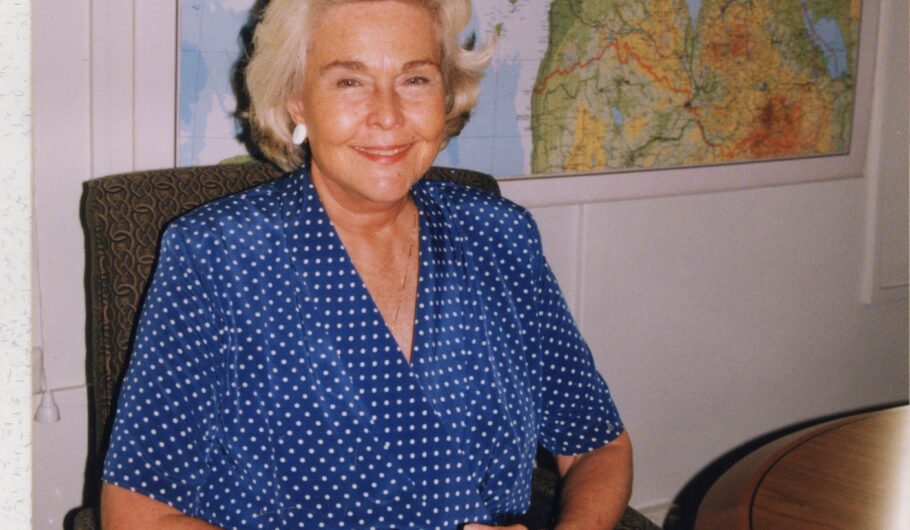
Ambassador to Estonia 1998 to 2001
Melissa had never been back to Estonia since she left as a baby in 1933. In the intervening years, Estonia had been occupied by the Soviet Union and once again was able to enjoy its independence starting in 1991. During these years, Melissa kept in touch with her Estonian heritage. In late 1997, it was clear that the post for US ambassador in Tallinn would become open the following year. Secretary of State Madeleine Albright, who was a good friend of Melissa, convinced President Bill Clinton to send someone who had been born there, who was one of America’s top diplomats and whose mother, Miliza Korjus, was Estonia’s most famous movie star.
Melissa arrived in the port of Tallinn in October 1998 on the ferry from Stockholm amid great media attention. Postimees, a major Estonian newspaper, highlighted the fact that she was the first woman in the US diplomatic service who did not give up her career after starting a family. When Melissa presented her credentials as ambassador (for the fifth time in her career) to President Lennart Meri, he took the document, gave it to an aide, opened his arms and hugged her, saying “Welcome Home”. Melissa and Meri had a good relationship, and he attended the US independence celebrations on the Fourth of July 2000, in pouring rain.
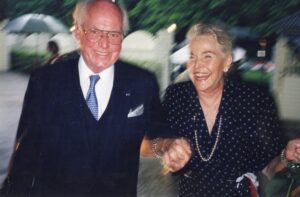
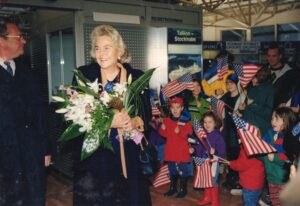
Read Postimees interview with Melissa upon arrival, in English, October 22, 1998
Read Postimees on Melissa arrival, in Estonian, October 20, 1998
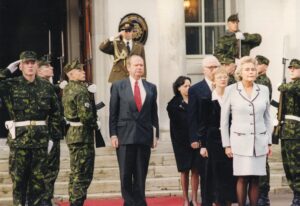
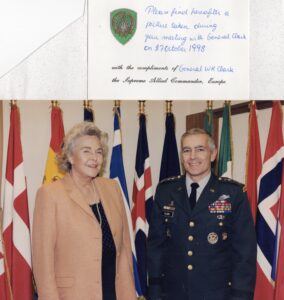
One of the key topics in her three years in Estonia was preparing its military forces for joining the North Atlantic Treaty Organization (NATO). There was close cooperation between the US and Estonian military, as well as joint exercises. This occurred parallel to Estonia’s negotiations to join the European Union, but Melissa saw no competition between these two initiatives. Estonia is now a member of both organizations.
Read Letter from Tarmo Kõuts, 2001
She encouraged young Estonians to dream about their future and act on their dreams, repeating the same message as in her address to Georgetown graduates in 1991. At a high school in the town of Vinni, on March 19, 1999, she said “You are young, you must dream. I had many dreams when I was young. My dreams have come true.”
Read Coaching talk by Melissa at Vinni school, Estonia, March 19, 1999
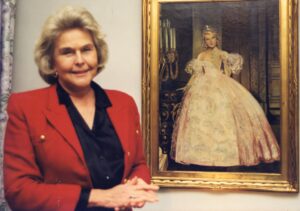
Wherever she went, Estonians would reinforce the link between her and her mother. A TV crew took her to where Miliza Korjus lived in Tallinn. An elderly man, who had been an Estonian Army officer and had spent 16 years in Siberia, came for lunch to talk about how he had met Melissa’s parents and seen her in a baby carriage. The press published many photos of her at events, almost always mentioning her mother. At her home in Tallinn, she kept a painting of her mother in a prominent place.
Read Melissa giving press interview in Estonia, 2001
Read Seltskond on Wells family in Kihnu, June 2000
Her work in Estonia also came out in the US press.
Read State Magazine about Melissa Wells in Estonia, September 1999
Read Mount St Mary magazine on Melissa Wells in Estonia, October 1999
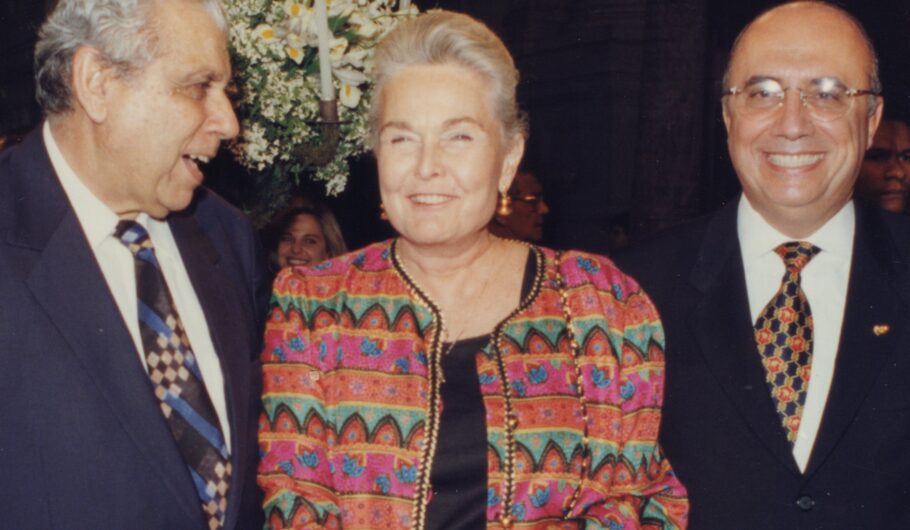
Several events in Tallinn were held in honor of Miliza Korjus. Two of them were in 1999. One was “Miliza Korjuse mälestusõhtu“, a memorial evening dedicated to Miliza Korjus with Melissa as a guest of honor. Her closest relatives Miliza Bunegina, (with her daughter), and Henno Korjus, with his wife and daughters, also participated. It was organized by Alo Põldmäe from the Estonian Theater and Music Museum.
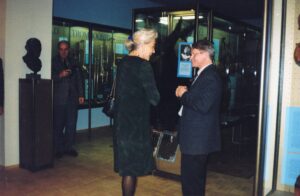
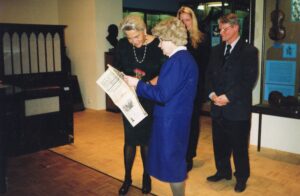
Another event was was dedicated to Miliza Korjus’ 90th anniversary, held in the Estonia Talveaed, the Winter Garden of Estonia Concert Hall. Melissa and her brother Richard, who lived in Los Angeles, donated a black dress made by famous fashion designer Hattie Carnegie to the Theater and Music Museum. Richard made a presentation about their mother.
She demonstrated the same concern for humanity that she had in Africa, this time focused on the Russian-speaking minority in Estonia. The embassy spent at least $150,000 on a project of job retraining in the region where this minority is concentrated. It was meant for both young people and for experienced workers engaged in information technology, business administration and cooking, for example.
A few days before finishing her tour (and retiring from the Foreign Service), Meri awarded Melissa one of the country’s most prestigious medals, the Order of the Cross of Terra Mariana Cross, First Class. Melissa, in reference to Meri’s “Welcome Home” message three years earlier, said she did indeed feel at home. She added that there was another member of her family who had received a distinction: the Cross of Freedom had been conferred on her uncle Helmut Foelsch, a hero from the war of independence in 1918-19.
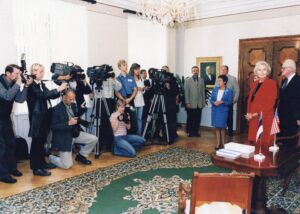
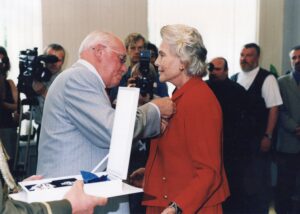
Melissa had a second retirement party in September 2001 (her first had been in 1997 in São Paulo when thought she was going to retire but didn’t). Her brother Richard attended and gave her a print of a article from a newspaper in Santa Monica, Los Angeles about her joining the US diplomatic corps.
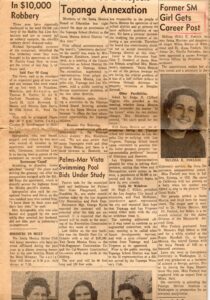
Melissa retired in September 2001 and moved to Agulo, on the island of La Gomera, in the Canary Islands, Spain.

UN Undersecretary General, New York 1993 to 1994
In early 1993, Melissa, who was serving as Ambassador in Zaire, was asked whether she would like to be a candidate to become the United Nations Undersecretary General for Administration and Management. This position is, in effect, that of the treasurer of the UN with additional responsibility for personnel.
“I went for an interview with the Secretary General [Boutros Boutros-Ghali], which was in March,” recalled Melissa in the ADST Oral History website. “I’d had seven years as a staff member with the United Nations Development Program earlier. That was the Uganda experience and then later in Geneva. I also had two and a half years with the US Mission to the UN. All in all, I’d had almost ten years of experience either in the UN or around it. So, he agreed to hire me and announced it the following day which happened to be International Women’s Day.”
Melissa’s predecessor had been Dick Thornburg, former governor of Pennsylvania. At the end of his one year in that position, he submitted a report to Boutros-Ghali that was widely praised. It recommended reform, restructuring, and streamlining efforts designed to make the United Nations peacekeeping, humanitarian and development programs more efficient and cost-effective.
There was also an anti-corruption initiative at the UN.
In early 1994, her assignment at the UN came to an end. Melissa later reflected on this period in her ADST Oral History interview, describing it as one of the most demanding and intense roles of her career, a position she characterized as “trench warfare,” where operational, political, and institutional pressures were constant and interwoven.
Read UN Staff Report, January 1994
Read Press reports on Melissa Wells leaving UN, January 1994
UN Undersecretary General, New York 1993 to 1994
In early 1993, Melissa, who was serving as Ambassador in Zaire, was asked whether she would like to be a candidate to become the United Nations Undersecretary General for Administration and Management. This position is, in effect, that of the treasurer of the UN with additional responsibility for personnel.
“I went for an interview with the Secretary General [Boutros Boutros-Ghali], which was in March,” recalled Melissa in the ADST Oral History website. “I’d had seven years as a staff member with the United Nations Development Program earlier. That was the Uganda experience and then later in Geneva. I also had two and a half years with the US Mission to the UN. All in all, I’d had almost ten years of experience either in the UN or around it. So, he agreed to hire me and announced it the following day which happened to be International Women’s Day.”
Melissa’s predecessor had been Dick Thornburg, former governor of Pennsylvania. At the end of his one year in that position, he submitted a report to Boutros-Ghali that was widely praised. It recommended reform, restructuring, and streamlining efforts designed to make the United Nations peacekeeping, humanitarian and development programs more efficient and cost-effective.
There was also an anti-corruption initiative at the UN.
Melissa tried hard to reform the system. She was also very receptive to hearing charges of sexual harassment of female UN employees and acting on them. In January 1994, after less than a year, Boutros-Ghali fired her.
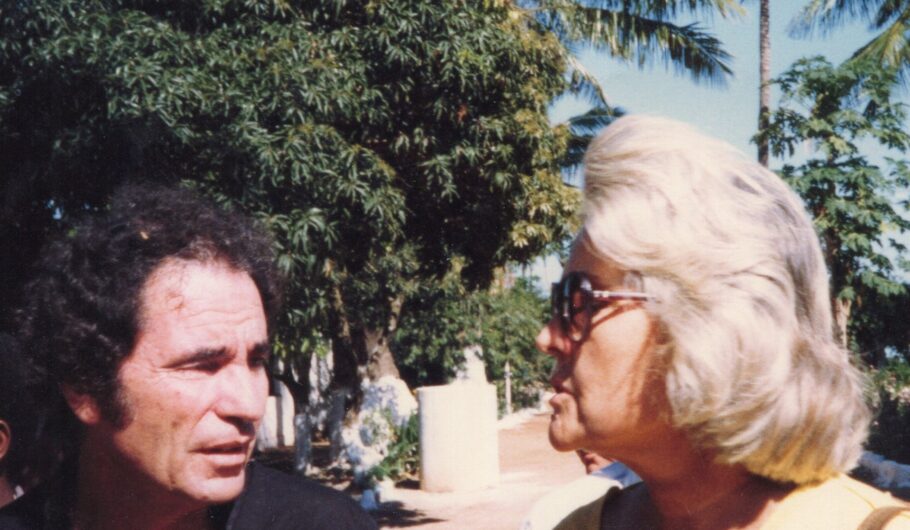
Albie Sachs
Albie Sachs, a white South African anti-apartheid activist, lived in Maputo at the same time as Melissa. The two met and shared similar views. He considered her “a most unusual Ambassador who was a true friend to Africa, remarkable as much for what she wasn’t as for what she was. “
Shortly after their meeting, apartheid security agents placed a bomb in his car. It exploded, blowing off Sachs’ his right arm and blinding his left eye, in addition to killing a passerby.
In 2025, when Melissa passed away, he sent this tribute.
“In the late 1980’s civil war was raging in Mozambique. We couldn’t leave Maputo except by airplane. It was in this context that I made a point of keeping up active contact with the British and the American ambassadors to the country. My wish was partly to pass on my own knowledge and insights in a way that would help the FRELIMO government withstand the attacks by Pretoria-backed RENAMO. But I also had a purely personal motive. I thought that if I was publicly seen to be friendly with these ambassadors, I would be less likely to be taken out in the way Ruth First had been by a letter bomb in 1982.
The British Ambassador, James Allan, was thoughtful, sparky and fun to be with. He also couldn’t help chortling at times. When telling me how he had encouraged Frelimo to receive military training from the British, he couldn’t hold back his chortles as he told me how he had encouraged Samora Machel to be measured for a military uniform made by the best British tailor.
Melissa Wells never chortled. Her relationship with Africa was totally different. She refused to see the continent purely in Cold War terms. Rather, it was a continent seeking to come into its own in the context of the Cold War. She had an affinity for African strivings that was almost unique in diplomatic circles. Together with this, though always self-assured, she was never self-important. I never felt that in my own dealings with her I should rely on diplomatic finesse. I could speak openly from my heart about how I saw situations. I noticed, too, that she seemed to surround herself in the Embassy with spirited and knowledgeable work colleagues. I think it was her openness of mind and practical empathy that made her particularly well-liked by large sections of the Mozambican community. She stood for values and a style of work not always found in her compatriots. You felt that speaking to her, you were engaging with someone whose organic connection with struggles by people in the US for their rights and dignity, enabled them to link organically with people in other parts of the world battling against injustice and oppression. As it turned out, my hope that being seen in the company of people like her would diminish the likelihood of an apartheid bomb coming my way, turned out to be illusory.
I learnt, however, that after Mozambican doctors had saved my life, the British Ambassador had assisted in my being flown out to a London hospital for my recovery. I never saw Melissa Wells again. But as I reflect on my interactions with her, I am reminded of the need to always be open to discovering warm-hearted, thoughtful, empathetic and forward-looking people in even the most unexpected places. In a world filled with greed, malice and ambition, she stood nobly and bravely for human virtue and dignity. I remember her as a good friend, a wise woman and a great American.
Albie Sachs
Former Justice of the Constitutional Court of South Africa “
Congo/Zaire 1991 to 1993
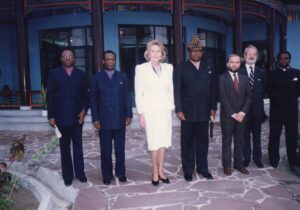
Congo, now Democratic Republic of Congo, was called Zaire in 1991 when Melissa was posted to the capital, Kinshasa. The US embassy there was the largest in Africa, with at least 300 employees. Zaire had been ruled by one of the world’s most corrupt dictators, Mobutu Sese Seko, since the early 1960s. With the end of the Cold War, both the international and local context of Zaire were changing.
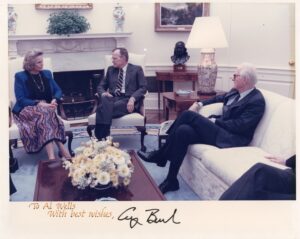
Melissa, who had been selected by US President George Bush, was already very experienced in working with African politics, and the press picked this up. Her husband Alfred wrote a letter to the family about the first developments after her arrival. She would soon be openly involved in local politics to an extent far beyond that for most US ambassadors. This would earn her the nickname “Tantine” or Auntie, in French.
“When I arrived which was in early June 1991, the main challenge was to take advantage of the opening in the political scene,” recalls Melissa in the ADST Oral History website. “President Mobutu had decided that political pluralism be introduced.”
“In other words, there could be a number of parties. At first, he had decided there should be only three parties. Everybody objected and then we started getting parties by the dozens. Everybody (…) decided to form a party. But in terms of major parties, and when I arrived and started making my contacts and finding out what they were hoping to do and how this political pluralism towards democracy is supposed to evolve, I was confronted time and again with the same issue. That was, ‘You, the United States, put him, Mobutu, there. You get him out of here.’
I just confronted it head on, and this is now June 1991. I said, ‘Look, let me make one thing very clear to you. The 82nd Airborne Division [a US paratroop unit] will never, ever be seen in Zaire. General Schwarzkopf has retired. Now what are we going to do next?’
[They would say]‘You liberated Europe from Hitler, etc.’
‘Excuse me,’ I said, ‘that was 1940s. This is 1991.’
‘We need a [UN] peacekeeping force.’ [They would say]. (…)
I said, ‘You mean like the Congo in the sixties?’ This was before peacekeeping operations became a land office business just a few years ago. I said, ‘Look, the world has changed. You don’t have a war on here to begin with. Peacekeeping operations cost money. We’ll all be killed while we’re discussing all of this.’ I said, ‘That won’t work.’
‘What are we going to do?’ I said, ‘You Zairians have to develop a transition plan which includes President Mobutu. Nobody is going to take him out. I’m not going to carry him out. He’s a bit overweight. A transition plan which includes President Mobutu and we will support you.’
And after much to-ing and fro-ing and trying to play the empty chair, the opposition said, ‘Well you know I’m not attending because they [Mobutu people] didn’t do this.’
I finally had to shake a few of these people and said, ‘Do you realize what you’re doing? You’re so dependent on the outside world. When are you going to grow up and wear long pants?’ In many ways I think it’s only a woman who can talk that way.”
All through this, she was concerned about a growing anti-American mood among Zairians.
Melissa earned the nickname Tantine, or Auntie, for her important role in supporting the pro-democracy movement in Zaire and for the wisdom she shared with the leaders of this movement. Click here for her role in the National Conference and the origin of the nickname Tantine.
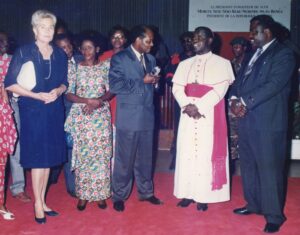
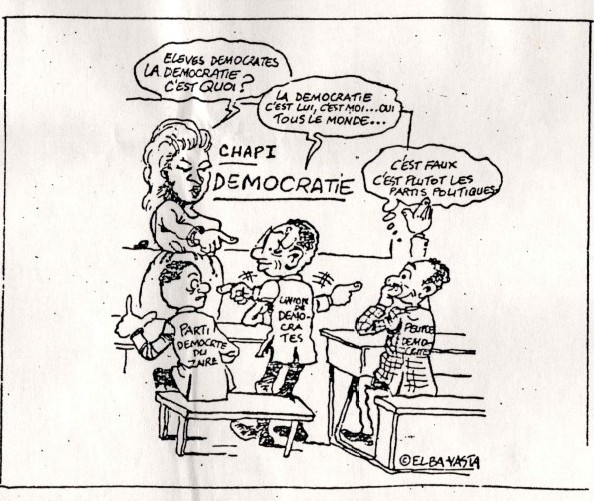
She received plenty of coverage in the Zairian press, both favorable and critical of her role in local politics. As in Mozambique, people started naming their daughters Melissa. An article entitled “A lesson signed by Tantine Melissa Weills [sic]” had a cartoon of her as a schoolteacher asking students what democracy is. Towards the end of her stay, the public-school teachers’ union sent her a letter of thanks for helping to spread education about democracy in the country. She watched at her residence, with the President of the Episcopalian Church in Zaire, the Hollywood musical in which her mother was a star, The Great Waltz. She received fan mail, including a handwritten letter that read, among things: “Je t’aime beaucoup depuis longtemps” and “I love you”.
She was realizing her dream of representing the United States in Africa.
Back in 1958 and 1959, when she had just joined the Foreign Service, she had twice filled out a form picking Elisabethville (now called Lubumbashi) as her number one choice for where she’d like to be posted. In a way, her dream came true, but with an ironic twist: she had to close the consulate-general in Lubumbashi. She had to go to the city several times. Once, she went on a private plane that, when it landed, was surrounded by people protesting US policy. “There was a very hostile reception – people, placards,” she recalled in the ADST Oral History website. “I knew the governor was behind it because you can’t come right up to an airplane at an airport. It’s fine to have all your demonstrators outside or inside the terminal or something, but to be right up there as the plane lands… So, obviously the governor [knew about] all this. (…) Very, very hostile signs (…) I saw this reception, and I made a point of walking by slowly and reading every single sign, shaking the hand of each of them, because they were really just trying to look ferocious. (…) I wanted them to know that I knew they weren’t really ferocious.”
“Now, going back to the troubles of September 1991,” she explained in the ADST Oral History website, “what happened was that with all the economic problems in Zaire, the army was very irregularly paid. They were late in being paid or only some of them were paid, but early in the morning on a day in September, we heard that a unit had mutinied out by the airport and that they had ransacked the international airport at Kinshasa, and that they were moving down the main road towards Kinshasa and of course the population was just joining them and looting everything in sight and burning cars and so forth. The long and short of this is that over a period of five to seven days we evacuated almost 3,000 Americans, including missionaries from the interior and so forth. Over 20,000 expatriates left Zaire, many of whom, most of whom have never come back.” Click here for more on the evacuation.
At least 300 people, including the French ambassador, were killed in this chaos. Melissa therefore was escorted by bodyguards wherever she went.
In November 1992, Bill Clinton won the US presidential election. As is custom, all US ambassadors must submit their resignations to prepare the way for the next administration. George Bush sent a standard letter to Melissa thanking her for her service.
In early 1993, news reached the Zairian press that Tantine had been invited to assume an important position at the UN. She was also being considered by the White House for the post of ambassador to Brazil, but the Zairians did not hear about this (and it never materialized). There were widespread reactions in Zaire by journalists interpreting her exit as related to local politics, which it wasn’t. A pro-Mobutu newspaper was happy to see her leave, going so far as to suggest that she needed a psychiatrist. The anti-Mobutu press saw it as some kind of trade-off and interpreted her leaving as a softening of the US position regarding Mobutu.
In her last press conference, Tantine praised the Zairians for their courage in fighting for democracy. To watch part of her statement, click here.
Shortly before leaving Kinshasa, she wrote a letter to Alfred, who had been evacuated to South Africa in 1991 and was living there. In it, she expressed her mixed feelings about what lay ahead and her concerns about the direction of events in Zaire.
She left in March 1993. She had realized much of her dream of an African adventure, having lived on the continent for eight years. She would work once more in Africa but would never reside there again.
Six years after Melissa left, Afrique Express, a continent-wide publication focusing on business, published an editorial praising her proactiveness.
In 2022, after she had moved to Maryland, she suffered a fall and had to be taken to a rehabilitation center. There she met a young male Congolese nurse. She told him that she had worked in Kinshasa and had earned the nickname Tantine. The nurse exclaimed: “Oui, Madame, I remember hearing about Tantine when I was a child!” Whenever he came into the room to help her, he would call her Tantine.
On December 16, 2025, the US Embassy in Kinshasa held an event honoring Melissa. The event included talks by three former high-ranking Congolese officials and a Congolese civil society leader about her work in the democratization process. The embassy produced about her role in that country. The video used images of a talk she gave in 2020, on the 60th anniversary of independence, together with images from Congo. Click here to watch. The event was organized by Ambassador Lucy Tamlyn, who worked at the US Embassy in Mozambique when Melissa was there.
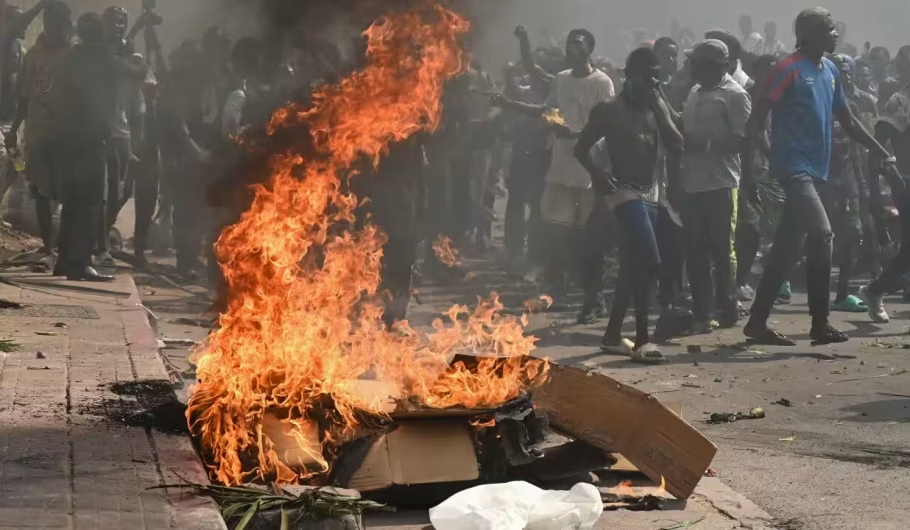
Congo evacuation
Congo, now Democratic Republic of Congo, was called Zaire in 1991 when Melissa was posted to the capital, Kinshasa. With the mutiny of the Zairian Army, which hadn’t been paid, on September 23, 1991, chaos broke out in much of the country. Melissa had to evacuate people who might be killed as soldiers looted stores, homes, churches, hospitals – everywhere. This evacuation was in addition to having to reduce the embassy’s staff, originally at around 300, by 90%. Her husband Alfred was one of the first to go, as she had to set an example. Within a few days, she had coordinated the evacuation of around 3,000 missionaries, businessmen, engineers, teachers, diplomats, their spouses and children – and their pets.
For example, an American doctor who was doing AIDS research in Zaire had to suddenly leave with his family. The Embassy’s computer chief recounted what he saw.
“As far as the US was concerned, haha, it’s not until you have to run an evacuation that you knew that you were responsible for Canadians, Israelis, and all sorts of other people that you never knew you were responsible for,” she revealed in the ADST Oral History website. “Special planes had to come in because the airport in Kinshasa was closed [due to ransacking by soldiers]. It was unusable and we had to get them across the Zaire River to Brazzaville. (…) We sent small planes in to get the people…. Most men, most of them, a whole bunch of them, came in from the interior who were missionaries and many of them didn’t want to leave. We’d send the plane out and they’d say, ‘No, we aren’t going anywhere.’”
There were many missionaries and their families in Zaire. Melissa sent a truck with armed guards (not soldiers) to the Presbyterian hostel in Kinshasa to pick up those missionaries and their families and take them to the Baptist missionary compound. However, the driver got confused and delivered the Presbyterians, numbering roughly thirty people, to her home, which was the large residence for the US Ambassador near the Congo River. Melissa was surprised but being “extremely gracious and unflappable”, in the words of one of them, took them all into her living room. These families were so grateful that, at the end of their stay, they gave Melissa a painting of an Okapi, which had been at their hostel, with all their signatures on the back. She kept this painting for years on the wall of her home until she died. The painting is now at the home of a reverend in the US.
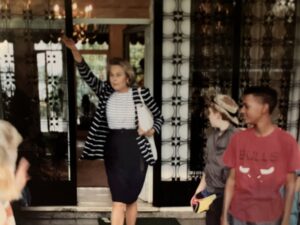
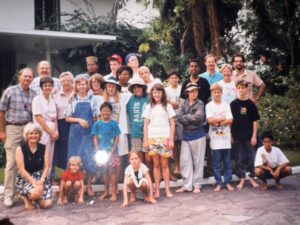
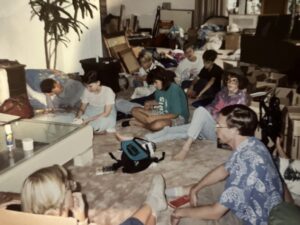
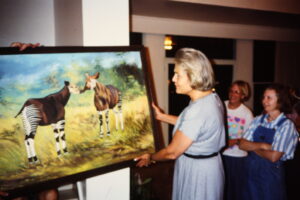
Several of the people who were evacuated wrote letters thanking Melissa. One of them was Ruth Dumont, who worked at a chimpanzee refuge and was acquainted with Jane Goodall. Here is her letter and obituary.
The State Department gave a $5,000 award to a Zairian employee at the consulate-general in Lubumbashi for his work during the evacuation.
Shortly before she left Kinshasa for her next post, The American School of Kinshasa sent a letter thanking her for the attention she dedicated to the teachers, parents and children.
Read American School of Kinshasa
“The evacuation of the humans was in September 1991,” she added in the ADST Oral History website. “And no sooner had they gotten to Washington, they were sending us messages, ‘Please send me back my cat,’ my dog, my parrot, my whatever.”
“So, the first thing we did, I wasn’t myself involved, but staff collected these animals out of the homes that had been abandoned. Most of the animals were cats and dogs. But we had a good number of parrots, birds, we had a couple of snakes — they were not poisonous. They were constrictor types. Amazing what people will collect! We had one little baby gorilla. But I think he was just on a visit. He wasn’t a permanent pet. We had a home for him right away on the other side of the river — a special place that [famed anthropologist] Jane Goodall kept.” Goodall dined at least once at Melissa’s residence and talked about her work with primates.
An American who worked at the US Embassy in Kinshasa wrote this account of the pet evacuation.
“On September 23, 1991, Kinshasa erupted into riots after a number of soldiers marched on government facilities, demanding higher pay. Within hours Kinshasa was extremely unstable, with widespread looting and over 100 deaths; by the next day Kinshasa was under an “ordered evacuation” status. Dependents (spouses/children of employees), as well as numerous employees deemed “non-essential” left on 25-27 September via ferries from Kinshasa, enroute to Brazzaville, Congo, on the other side of the famed Congo River. Our embassy staff was reduced dramatically at this point, to just 41 personnel, from a previously large number of official personnel. By the weekend, however, things continued to destabilize, and five officers were selected to evacuate to Brazzaville, with hopes that we would be able to return in a reasonable amount of time.
Being among the five officers chosen to go to Brazzaville, we all reported for duty on Monday, 30 September, only to learn that the embassy did not have much for us to do, so we settled in the embassy conference room, and began watching the Clarence Thomas hearings. The next day, again while we were watching the hearings, the Ambassador’s secretary summoned me, saying the Ambassador needed to see me. Being assigned to the political section in Kinshasa, and being a competent French speaker, I was hoping that I was either going back to Kinshasa, or the Ambassador might have some special mission for me. He did indeed have a special mission. The Ambassador said he had just gotten off the phone with Ambassador Melissa Wells, my Ambassador in Kinshasa, and she had an important assignment for me – I was to be the pet evacuation officer. The Ambassador in Brazzaville told me he would put his General Service’s Office (GSO) at my disposition and advised me to get in touch with the pet evacuation coordinator on the Kinshasa side – Dr. Cedric Dumont.
I called Dr. Dumont, who I knew well, and learned that Ambassador Wells was very concerned about reports coming to her that personnel who had been evacuated had left behind a significant number of pets, and the Embassy was having trouble caring for the pets. Furthermore, there were some reports that some families had reportedly killed their pets before their departure, as they feared looters would eat their pets. Ambassador Wells recognized that the State Department could not officially evacuate pets but asked for input about how they could facilitate the movement of pets to the United States. A solution was found – each employee, whether State or another agency – would have to agree to cover the costs of shipping their pet(s), to include the cost of an accompanying officer. In the end, everyone agreed to this, and Ambassador Wells appointed Dr. Dumont for the Kinshasa side and me for the Brazzaville side.
We had some challenges ahead of us. There were 63 dogs and cats to be evacuated, as well as seven chimpanzees from the Kinshasa zoo. I had been with my family several times to the zoo and they previously had about 30 chimps. However, hungry citizens broke into the zoo and began eating all the animals. Only seven chimps remained and Jane Goodall, who was an occasional visitor to Kinshasa, agreed to take the seven to her chimpanzee reserve in the Republic of the Congo. Dr. Dumont worked with GSO on the Kinshasa side to assemble all of the animals, build crates for those who did not have crates, and also to put together shot records and papers, and if there were not any, to come up with suitable substitutes.
On my side the GSO shop from Brazzaville was terrific. I worked with the GSO to book a ferry and three trucks, who would take the animals off to different locations after arriving from Kinshasa. We wanted to take care of all this as soon as possible and if memory serves me correctly, we got the word on Tuesday, and the first animals (the cats) left Brazzaville on Friday, October 4th, followed by the dogs on October 5th. How we got to that point deserves some elaboration.
I first went to the downtown Brazzaville office of UTA, a French airline that has since been taken over by Air France. I explained to the French expat my dilemma – having to send 62 cats and dogs to the U.S., to various locations, and one cat to South Africa. His first reaction was raucous laughter. After I managed to convince him that I was serious, he gathered himself and said that we would have to put the cats and dogs on separate flights, and each flight would have to have an accompanying officer. He said that he did not want the cats and dogs fighting, since they were well known for such activity. I looked at him and said, “You are looking at the only potentially accompanying officer.” He relented and said the cats could go alone, but I must go with the dogs.
Dr. Dumont quickly sent all of the paperwork for the animals over before “d-day,” and then, with the paperwork in hand, went over the next day to the airport and diligently filled out all paperwork for the cats. There were 30 cats going to the US, so this took a lot of time. They were going to Paris, then to Dulles, and then some going to further locations. I fortunately had a GSO Foreign Service National (FSN – acronym for locally employed staff at the time) with me, and he helped with translation, since my Congolese counterparts often preferred the local language to French. I announced to the UTA shipping office that I was then taking off for Kinshasa to go get the cats and dogs and would be back in a couple of hours with the cats, who were leaving that night.
I headed to the port and got on my ferry, which was captained by a Congolese woman, which was a rarity then, as it is now. The current slowed us down and the voyage took longer than expected. When I got to the other side, I could see all of the animals stacked up in their crates, with Embassy staff all around, but behind a locked gate. Not good. I managed to get inside the locked gate, and encountered a still chaotic refugee scene, with people trying to flee Kinshasa and Zairian troops and policemen swinging rubber hoses and truncheons, while well-coiffed French and Belgian paratroopers eyed the scene carefully. I asked the head GSO representative what the problem was, and he said he didn’t know, so I grabbed him and headed to the headquarters building of the port. Having already served for a time in Kinshasa, I was wise to the rampant corruption and schemes and expected we had a hold-up due to an effort along those lines. We were directed to the Commandant’s office and I asked, in French, what the hold-up was, and he said we “had not paid the special pet export tax.” I of course knew that this was a blatant attempt to shake us down and I explained this to my GSO colleague, who was not a French speaker. When he heard this, he replied (in a barely contained rage), “you tell him that if he does not open the gate immediately, we will have one of the French paratroopers shoot off the lock.” The commandant replied immediately, “ca va” (okay), indicating that he knew some English and we were in no mood for his shenanigans. This was none too soon, as it was hot on the dock and we were worried about the animals.
The “portering” of animals began in earnest. My ferry was actually tied up next to a ferry already on the dock, so the myriad Zairian porters carried animals, big and small, across one ferry to another. It was quite a spectacle, especially with chimps reaching out and trying to grab people and their hats in some cases, as they were carried onto the ferry. As I was watching this, a Zairian guy came up to me and said he had just learned that my ferry was broken down, but he could offer me a special price. Again, being wise to the ways of the infamous Zairian kleptocratic methods, I asked him to wait for me, and I went aboard my ferry, only to find my ferry captain in the middle of a black-market transaction. Fortunately, it was only for soap and when I asked her if her vessel was fine, she said of course it was. The “ark” was now full and we set sail for Brazzaville – well within sight – but it still had me reflecting on the fact that we were ferrying unusual cargo across the dark and mysterious Congo river.
We got the other side, but we were well behind schedule. GSO was well organized, as the three trucks were there; one took the dogs to the GSO compound, another took the chimps to Jane Goodall’s reserve, and I got into the truck with the cats and we headed to the airport. When we got there, I apologized for being late, and said the cats were ready to go. The UTA clerk tapped his watch, and said it was too late, and anyway, they had already gotten rid of all of the paperwork that I had so painstakingly filled out. It was my turn to speak English and demonstrate some ire, and turning to my Congolese FSN, I asked him to convince the UTA employee that he better change his mind right away. He did, but I had to fill out all of the paperwork again. Fortunately, I had copies of all of the documents with me. I finished up, and I stood by while the UTA warehousemen put all of the cats onto a pallet and secured them with bungee cords. I verified they had the requisite paperwork and then took off, saying I would see them the next day with the dogs.
I got back to the warehouse and found 32 dogs sitting there in their crates, waiting for me. Unfortunately there was no one else to help me, but I knew that dogs were much more needy than cats, so this involved walking, feeding and watering all of the dogs – all except the mean one who would not come out of his cage and always snapped at me – he got the food and water hurriedly pushed in but no walking. This whole process took about two hours. I made it back to my hotel, weary, but excited to be going the next day, as I would be going back on the flight and I would thus being seeing my wife and two young children (4 and 2), who had just been evacuated to the DC area.
I went to the GSO compound early the next day and a teenaged boy (son of an Embassy staffer) was there to help me with the walking, watering and feeding of the dogs. I then headed to the airport and filled out all of the paperwork. After that was completed, we went back to get the dogs. At the airport I decided that they should be walked, watered and fed again (except again for the mean one), before being palleted. I handled this myself, and it again took two hours. They were palleted under my supervision, and I again verified that they had all of the paperwork. I headed back to my hotel and showered and packed, and hustled back to the airport. I checked in with UTA, and given that this was 1991, there was a lot more flexibility about security, so they let me exit the terminal so I could just check on the dogs one more time. I remember there was a pleasant, light rain falling. When I got to the dogs, I saw two people climbing up on the stacked crates of dogs, and it turned out to be the Ambassador’s wife and none other than Jane Goodall herself. The Ambassador’s wife asked me, “Steve, could you help us get these dogs out, since they need to be walked before the leave?” Although the notion of walking dogs in the rain and having all of that dog hair on me for my transatlantic sojourn crossed my mind, of course I responded in the affirmative. We took all the dogs out (except for the mean one) and walked them, and then I had to put them back in, and invite the UTA warehouse guys to re-band them with bungee cords. Needless to say, I smelled like a dog for my flight.
After arriving in Paris, I was worried about the dogs, and asked all around if there was some way for me to get to the cargo area so I could check on the dogs I was accompanying (there was a several hour layover). Finally a UTA employee took pity on me and drove me in his personal (very tiny and very old) car to the cargo area in the middle of Charles de Gaulle airport. As soon as I arrived, the first thing I heard was someone yelling, “Where did all these cats come from?” The cats were already supposed to be in Washington, so this was not a welcome news item for me. Thank goodness I showed up when I did, as sure enough, the cats did not arrive with paperwork and they had no idea where they came from and where they were going. I dealt with that, since I had all the paperwork. Next a guy came up to me and said, “Oh monsieur, one of the cats escaped earlier.” I quickly determined that the escaped feline was from a true cat-lover and this was going to be a real problem, but not one I could solve. I then sat down with the UTA folks and booked onward travel from Dulles for several animals. Then naturally I turned to my old friends the dogs and did the needful – walked, watered and fed them (except for the mean one). My UTA contact that drove me waited for me the whole time, then drove me back, and marveled at the whole affair. One important point – after all my efforts, the UTA folks said the cats and dogs were allowed to fly together!
On the flight, flight attendants passed out newspapers, and I grabbed a copy of USA Today’s international edition. I was surprised to see a short mention of a “Noah’s Ark” operation from Kinshasa. It mentioned my voyage, but it only mentioned Dr. Dumont – not me. Oh well.
I got to Dulles and made my way to the cargo area. I could see my wife and two kids making their way to me, in a sea of former Kinshasa colleagues. Just before I hugged my wife, the woman whose cat had escaped came up to me and asked how her cat was. She was not aware of the escape, so I broke it to her gently that her cat had escaped. She laughed off what she thought was my weak attempt at humor, but I assured her I was not kidding. I saw someone assisting her as she stumbled away, sobbing. I later learned that this employee called the UTA Washington office so frequently that they began putting out food and milk to attract the cat, and lo and behold, it came back! UTA flew it home for free.”
To learn more about the pet evacuation, or petevac, click here.
São Paulo
Brazil, in 1995, after battling inflation for 15 years, had finally killed it with an economic plan called the Plano Real. Inflation, which until 1994 would often reach one percent a day, was now in the single-digit range. One of the side effects of the Plano Real was that the new Brazilian currency, the real, started rising steadily against the dollar. For Brazilians dreaming of their first visit to New York or Orlando, this was a godsend. Suddenly, the US was a cheap place to go on vacation. But the US Consulate-General in São Paulo, Brazil’s largest city, didn’t have enough people or physical space to issue hundreds of thousands of visas. The waiting lines of visa-seeking tourists went around the block. People stood patiently for hours, clutching envelopes with passports, forms and photos, not certain if they would get to talk to a visa officer that day. If they couldn’t get to the US, they couldn’t spend tourist dollars there – and that was bad for business.
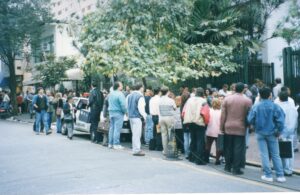
One of Brazil’s most famous cartoonists, Luis Fernando Veríssimo, published a cartoon that read: “They sell everything on the beach”, then (someone off-screen shouting) “I’m selling places in line for US visas!”, then “Everything”.
This was the challenge facing Melissa when she arrived in May 1995. By the end of her stay in December 1997, she had developed a system for processing visas more efficiently that was copied by US consulates around the world.
Former US President Jimmy Carter visited São Paulo and in January 1997 wrote to then President Bill Clinton that “Mrs. Wells has instituted remarkably effective procedures for issuing more than 350,000 visas a year with practically no long lines or delays. She utilizes the cooperation of approved travel agents, a common computer hook-up, and 1-900 calls-ins that accomplish what we have never seen in any place where there are voluminous visa demands.”
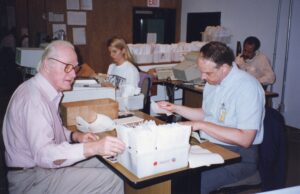
In the early months of this challenge, she made her husband Alfred work on helping process visas. Her brother Richard, when he visited, also had to work on visas. They were not paid but got free lunches.
Melissa helped promote business in both countries. With Wisconsin Governor Tommy Thompson, she posed on a Harley-Davidson motorcycle. She toured the factory of aircraft maker Embraer, which sells jets to US airlines. She would meet with key Brazilian business leaders. She also gave press interviews. And when African students in São Paulo discovered that she had worked in Mozambique, she was invited to speak at an event on her experience there.

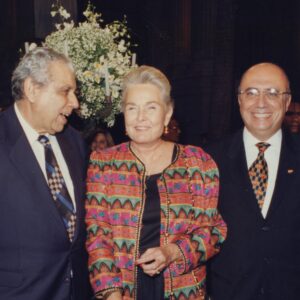
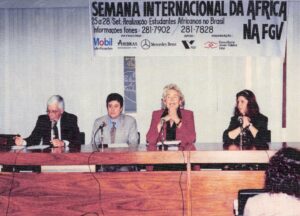
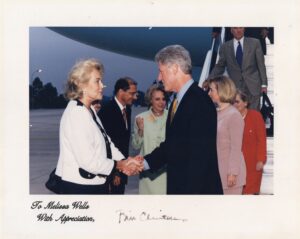
In October 1997, US President Bill Clinton visited São Paulo, accompanied by Secretary of State Madeleine Albright, who made a point of introducing Melissa to the president. When Melissa mentioned that she had studied at Georgetown, Clinton asked if she had taken classes with Prof. Quigley, Melissa replied, “Yes, and he would read my papers in class as an example of excellent work”.
“He never read any of my papers,” Clinton said. Albright then changed the subject.
The Clintons stayed at the Mofarrej Sheraton hotel and one evening asked Melissa if she could get some of the delicious steaks that Brazil is famous for. She went to her favorite steakhouse, or churrascaria in Portuguese, Barbacoa. When she arrived, together with some of the president’s security team, she explained to the manager that she wanted to order some food to take out.
“But senhora Melissa,” the manager said, “we don’t do takeouts.”
“This is for somebody very important,” Melissa insisted, without mentioning names.
The manager was adamant. Right then, Madeleine Albright walked by and the manager recognized her. Melissa said, “This is for someone even more important.”
His eyes opened wide, and he allowed the presidential security team to go into the kitchen and make sure that the food was in order. The Clintons enjoyed the steaks very much and complimented Melissa.
As her time in São Paulo ended, she planned to retire. Her work colleagues prepared a farewell party with a play that recounted her life. The play coincidentally took place on Halloween.

Two retired Foreign Service Officers who worked with Melissa in São Paulo, Gil and Linda Donahue, sent a tribute with stories. Gil and Linda are both retired US diplomats who, in the seventies, faced a similar challenge to that of Melissa and Alfred: the unwritten rule that married couples couldn’t work at the same post. From 1971 to 1974, they served in Mexico. They married in August 1973, and Linda was expected to resign. The US Minister Counselor for Consular Affairs in Mexico City, Margaret Hussman, convinced the personnel department in Washington to have Gil moved to where Linda was stationed. After that, the couple was able to be assigned to the same posts up to when they retired in 1998.
Melissa was all set to retire at the end of 1997. But then another one of her dreams would come true: to return to the country where she was born.
Congo National Conference
The following quoted text is from an e-mail that Melissa wrote in 2015 to a close friend. It contains excerpts from the ADST Oral History website.
“When I arrived in Zaire in May 1991 as the new U.S. Ambassador, the country was beginning to organize itself for a process of democratization. In 1990, President Mobutu had begun to succumb to international pressure to give up the one-party state rule and democratize. In September 1991, the army mutinied because it had not been paid in several months and went on a looting and torching spree. We evacuated over 3,000 Americans from the country, many of them missionaries from the interior of the country. French and Belgian military forces arrived to restore order. The Embassy staff – which was the largest American Embassy in Africa – was reduced to minimal size and all dependents left, obviously including my husband.
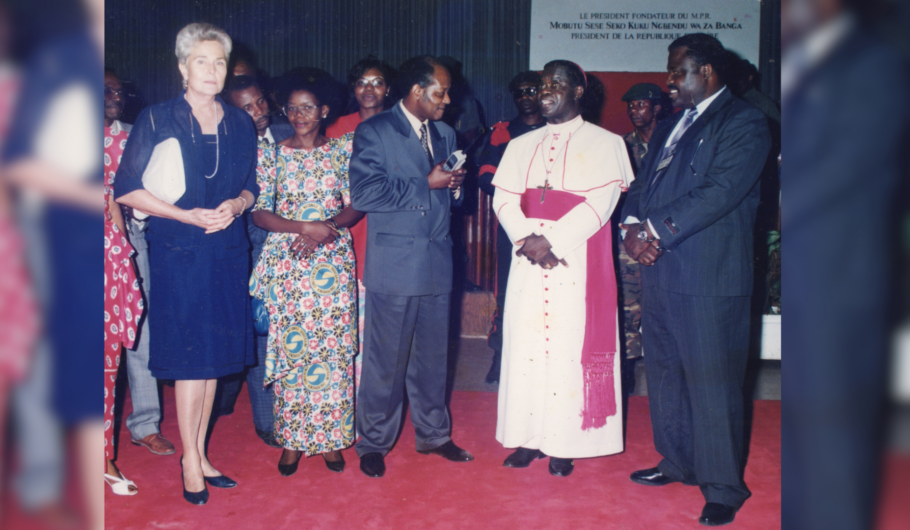
Once order was restored in Kinshasa, a National Conference was organized in early December 1991 to discuss how best to proceed with an eventual democratization process. Archbishop Laurent Monsengwo of Kisangani was selected to chair the National Conference, which was also supposed to draft a new constitution to be approved by national referendum. There were several thousand delegates to the National Conference, representing Zaire’s nearly 40 million people and some 200 ethnic groups.
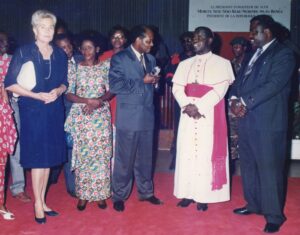
But by the following month, it became clear that a real change of government was sought by the National Conference, who were intending to elect Étienne Tshisekedi, founder of Zaire’s only opposition party, as prime minister. Mobutu suspended the Conference and thereby encouraged strong support for the opposition party.
Protesters planned a March of Hope for a Sunday. Leaders planning the March of Hope came to see me at the Embassy several times asking for details of the US non-violent civil rights protests that Dr. Martin Luther King, Jr. had organized. They came into the library [at the embassy] and they read about King and so on. It was entirely peaceful. It was church-based. In other words, the demonstrators would all collect in churches, Episcopalian, Presbyterian, whatever. I gave them as much information as I could.
On the given Sunday, I gave strict instructions to all remaining Americans in Kinshasa not to leave their homes. Together with a few of my colleagues, I spent the day at the embassy. We were visited numerous times by bleeding clergy and protesters who described with what brutality the non-violent protest was being suppressed. While there were protests in other cities in Zaire, the estimate in Kinshasa was of several tens of thousands of protesters.
People started coming in, priests all bloodied up with torn cassocks. Phone calls. You knew something awful was going on but you didn’t know exactly what. Then the political counselor was there, and at about four in the afternoon, I said, ‘All right, put all the flags on the car, on the Cadillac, we are going to the hospital. I don’t know if we’re going to get in or not. But we’re going. I want to see what’s happening.’
We drove up to the hospital. I thought they might try to stop us. No, they let us in. We went into the hospital. I was overwhelmed with people. I talked to the wounded, those who wished to speak at all about anything. I saw the injured and, from those who spoke French, heard their stories. We went down to the morgue of the hospital and saw the victims with fresh trauma wounds who did not survive.
And I had my own report to make. I happened to have a meeting with – we had what we called a troika, the Belgian, French and US [ambassadors] – President Mobutu the following day. But I had a firsthand report of what happened, not just sitting and listening to phone calls. Then I reported it to Washington. They asked me, ‘Did they march and so forth?’ This was never shown on television, but a lot of people knew.
A few weeks later, when the Rodney King riots occurred in Los Angeles, Prime Minister Nguz Karl-i-bond, who was responsible for the brutality of the suppression, had an announcement on local TV, that he had not instructed the Zairian Consul in Los Angeles to check hospitals for wounded Zairians! My phone started ringing off the hook apologizing for the prime minister.
During this period, I also received a phone call from Archbishop Monsengwo. He was terrified, saying that he would be killed, that his home was surrounded by armed men.
I asked the political officer to accompany me, got into the official Cadillac once again with the flags flying (there are two flags: one is the US flag, and the other is the official ambassador’s flag) and drove to the archbishop’s home. There were armed men outside, but nobody stopped us, and we went in and found the archbishop hiding and extremely nervous. We stayed with him for several hours and I offered to take him to the Embassy, but he refused. The armed men left and so did we.
Later, I received instructions to deliver a very tough message to Mobutu to reconvene the National Conference. Mobutu was on his large boat, far up the Congo River. He sent his helicopter to pick up me, my deputy and my diplomatic security agent, sent by the State Department after the army mutiny. My meeting with Mobutu was on a one-on-one basis, as I had requested. Mobutu became upset and threw his leopard cap on the crystal coffee table. As a storm was approaching, we had to leave on the helicopter.
The ride back is described in a (…) book Taking Up the Sword written by [Randall Bennett,] the security agent. Not only were we very low on fuel but could not find the helicopter landing spot in the pitch-black darkness as there was a power outage in Kinshasa. (…) One of the other security agents, who was concerned by the power outage, raced to the helicopter landing [and] signaled us with a flashlight. Our landing spot was next to the extremely dangerous rapids of the Congo River. We were saved from landing in the rapids by a pocket-size laserlite flashlight.
The National Conference was reopened [in April 1992].”
The reopening marked a popular victory against Mobutu’s authoritarian control, showing the strength of civil society and opposition movements. It also set the stage for Zaire’s attempted transition to multiparty democracy, though instability and Mobutu’s resistance continued to undermine reforms.
“It was Archbishop Monsengwo who gave me the lovely nickname ‘Tantine’ (Auntie) and spread its usage among Zairians,” she recalled. Monsengwo in 2010 became a Cardinal and in 2013 was appointed by Pope Francis to advise him on revising the Apostolic Constitution on the Roman Curia.
During the period that the National Conference had been shut down, a reader of Le Soft de Finance, a local publication, sent in a letter about how active Melissa had been, entitled “Melissa wants her President”.
In her talk on the ADST Oral History website, Melissa gave details about the origin of her nickname and her role when the National Conference opened.
“As a result, and I spoke out very frankly, I acquired a wonderful nickname, a sobriquet which I shall treasure for the rest of my life. Tantine. Auntie. Now at first I said, ‘Tantine? Is this because of Uncle Sam and I’m a woman, is this Auntie Sam or what does this mean?’
I mean I speak French, Tante is an aunt. I said, ‘But why a tante?’
‘Oh, no, but don’t you know the expression Tantine? [Presumably Monsengwo said this.] Tantine may or may not be related to you by blood as an aunt should be. A Tantine is a senior woman in the family to whom you come and tell your troubles to and get good advice.’
And one of the most wonderful moments of my entire career was when this National Conference had reopened. It had been closed by Mobutu for some time, and the US had applied an enormous amount of pressure, and I made damn sure that everybody knew that we were doing this. And then the National Conference was reopening, and the diplomatic corps was asked to attend, and they had a special section down there at the front and as usual, I’m late. I pull up in the official car with all the flags flying. I could see all the other ambassadors and their flags, and their drivers are sitting over there, and I go running up the stairs and I’m trying to figure out which door to go in.
‘Where is the diplomatic section?’
‘That way, that way, madam.’
I start walking, I start running almost, walking fast down this aisle to get to the front. And then I hear applause, and I thought, ‘Oh dear God, Monsengwo is coming and I’m in front of him. I start looking around and there’s no Monsengwo and I see people looking at me and clapping “Tantine, Tantine, Tantine.”
Well, it didn’t take me long, to stop running down the aisle and to absorb fully for the US government and for Melissa Wells in person. I acquired a very regal step coming down the aisle. I sat down in my proper place. Of course, my diplomatic colleagues are saying, ‘My God, what an entrance you made.’ Never mind. Never mind.”
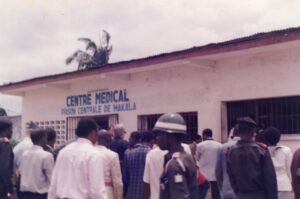
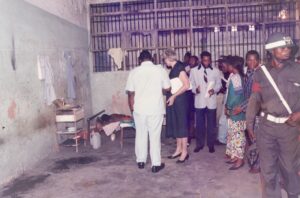
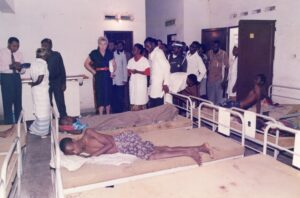
On October 30, 1992, Tantine made another visit to people who had been protesting in favor of democracy. This was to the infamous Makala prison in Kinshasa. Here are photos of her visit. Her visit generated both support and criticism – and a letter from an NGO defending her against an editorial in a pro-Mobutu newspaper.
Keeping in touch with Estonia
As an Estonian-born US diplomat, Melissa Foelsch Wells kept in touch with Estonia during much of her career. Up until 1991, Estonia was under the occupation by the Soviet Union, having been invaded in 1940. The US government never recognized the incorporation of Estonia, nor of the other two Baltic states, Latvia and Lithuania, into the Soviet Union.
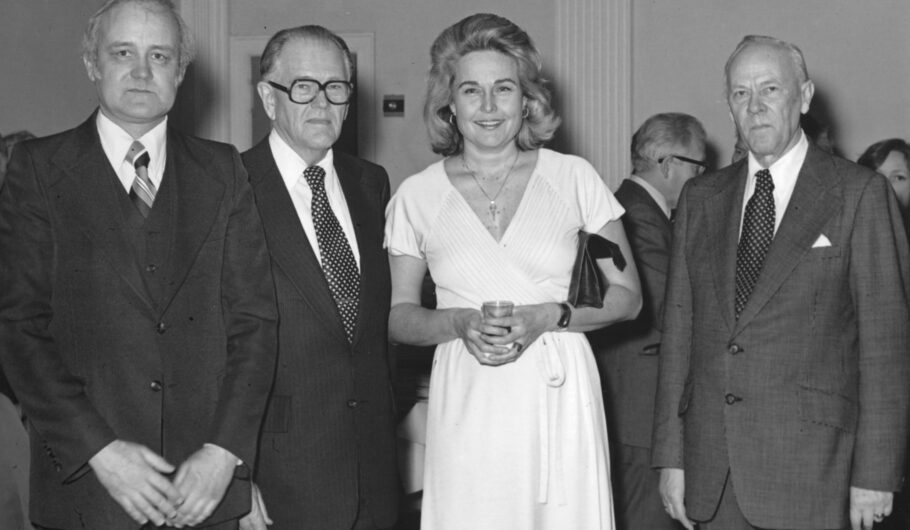
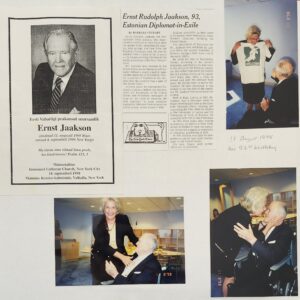
Her main contact was Ernst Jaakson, who was Estonia’s representative to the US during all the years of Soviet occupation. They met several times during the seventies and eighties, always in New York, where he lived. When the country regained its independence in 1991, he became the ambassador for two years. On his 93rd birthday, in 1998, when Melissa knew that she would be going back to her native land, she met him for the last time. He died a month later, perhaps sensing that his mission had been accomplished. Melissa kept photos of Ernst in her album.
In 2025, the city of New York named a section of 34th Street after Ernst Jaakson.
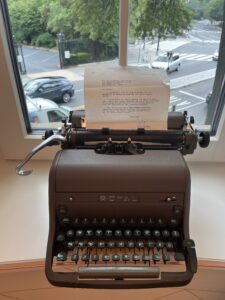
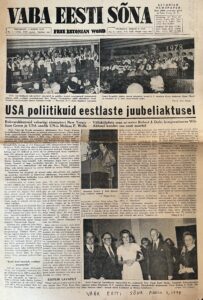
In her various posts, she would receive letters from people in Estonia, even when it was occupied by the Soviet Union. In 1991, when she was Ambassador to Zaire, Estofilm sent her a letter.
She also did research on her family background. She visited an island off Finland in the eighties with distant cousins from her mother’s side to visit a graveyard of the Korjus ancestors. Further research by her cousins in Estonia revealed, however, that these graveyards do not contain the remains of relatives despite bearing the name Korjus. She came out in a Finnish magazine, Kotiliesi, in 1982.
When Melissa was stationed in São Paulo, she met the Estonian Consul there, Jüri Saukas, and became friends. In 1997, he went on a business trip to Tallinn – before Melissa had been considered for ambassador – and, at her request, he contacted cousins from her mother’s side of the family in Tallinn. Her son Christopher visited the cousins a few months later. When Melissa was ambassador, they became close friends and remained so for the rest of her life. Her sons keep in touch with their Estonian cousins.
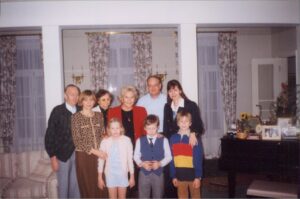
During her time as ambassador in Tallinn, she used her diplomatic contacts to collect information on her ancestors. Diplomats from Russia, Germany and France helped with documents.
After retiring in 2001, she went back almost every summer to Estonia to visit her relatives and her former colleagues from the US embassy there. People on the street would recognize her and welcome her back.
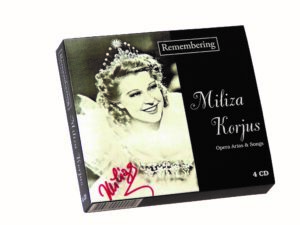
Shortly after retiring, she hired Jüri Kruus, a sound engineer/sound director/restaurator to digitally remaster those songs of her mother for which she had copyrights. The result was a beautiful set of four CDs with a booklet that was sold in Estonia and online.
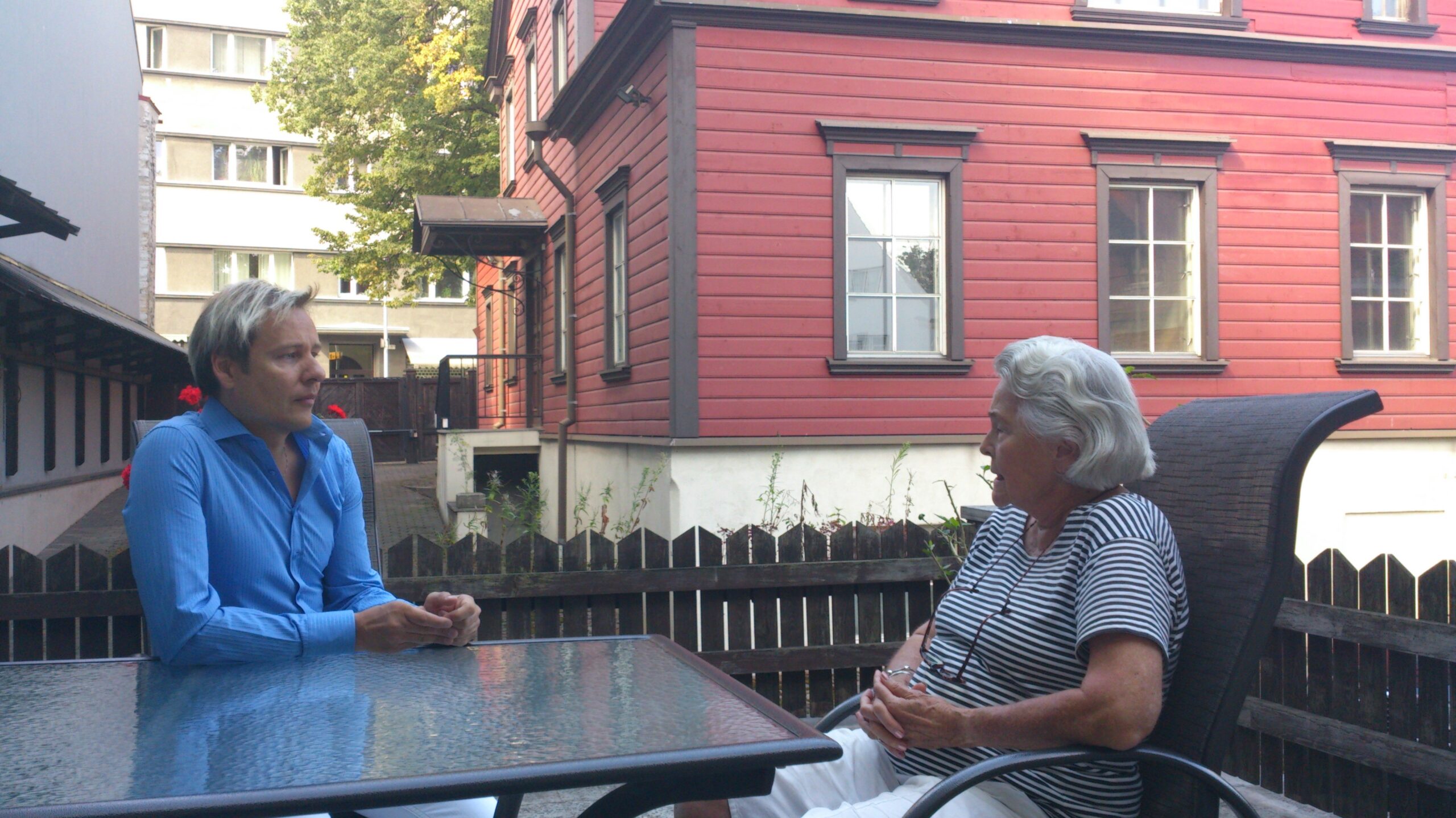
In 2012, Jaak Jõekallas, an Estonian author, published a book in Estonian about her mother, Unustamatu Miliza Korjus (Unforgetable Miliza Korjus). He interviewed Melissa several times at the home of her cousins in Tallinn had the book translated into English. Melissa had plans to try to publish it in English but this project did not move ahead.
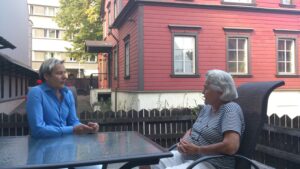
In 2021, she moved to Washington, DC. There she had dinner in 2023 with the Estonian Ambassador, Kristjan Prikk, during which they discussed both current affairs and her time in Tallinn. He attended her funeral on July, 21, 2025 and maintains contact with her sons.